
Rates · Bank rules
UOB One interest rate calculator
Your UOB One rate and interest from your balance, salary, GIRO bills and card spend, worked out slice by slice from UOB’s own rate table, and whether UOB Stash, OCBC 360 or DBS Multiplier would pay you more.
UOB One top rate · read 24 Nov 2026
1.90% a year
On exactly S$150,000, with a salary and card spend
UOB pays 1.00% on the first S$75,000, 2.50% on the next S$50,000 and 3.40% on the next S$25,000, so the 3.40% it advertises is paid only from S$125,001. Below S$75,000 every route pays 1.00% at most. From S$29,500 to S$122,500, UOB’s own Stash Account pays more, with no salary or card spend.
Rate on S$150,000, % a year
- UOB One, card + salaryat S$50,000: 1.00%1.90%
- UOB One, card + 3 GIRO billsat S$50,000: 1.00%1.18%
- UOB One, card spend onlyat S$50,000: 0.65%0.35%
- UOB Stash, no salary or cardat S$50,000: 1.29%1.30%
- OCBC 360, salary + cardat S$50,000: 1.30%1.05%
- DBS Multiplier, salary + cardat S$50,000: 1.80%0.63%
Rate on the whole balance, from each bank’s rate table; salary S$3,500 and S$500 of card spend a month, OCBC with today’s rates. Bars start at 0%.
Salary and card, S$50,000
S$500
a year: 1.00%
Every dollar up to S$75,000 earns 1.00%, whichever route you are on.
Where UOB One starts to win
S$107,500
against OCBC 360
With a salary and S$500 on a card at both banks. Against DBS Multiplier: from S$82,000; against UOB Stash: from S$122,500.
The best-paid S$25,000
3.40%
from S$125,001 to S$150,000
With a salary and card spend. Above S$150,000 it drops to 0.05%.
Work out your rate
Put in your average balance and what you do in a normal month. The calculator finds which of UOB’s three routes you are on, works out each slice the way UOB’s terms describe, and shows the change that would add the most. It also checks whether UOB’s own Stash Account would pay you more.
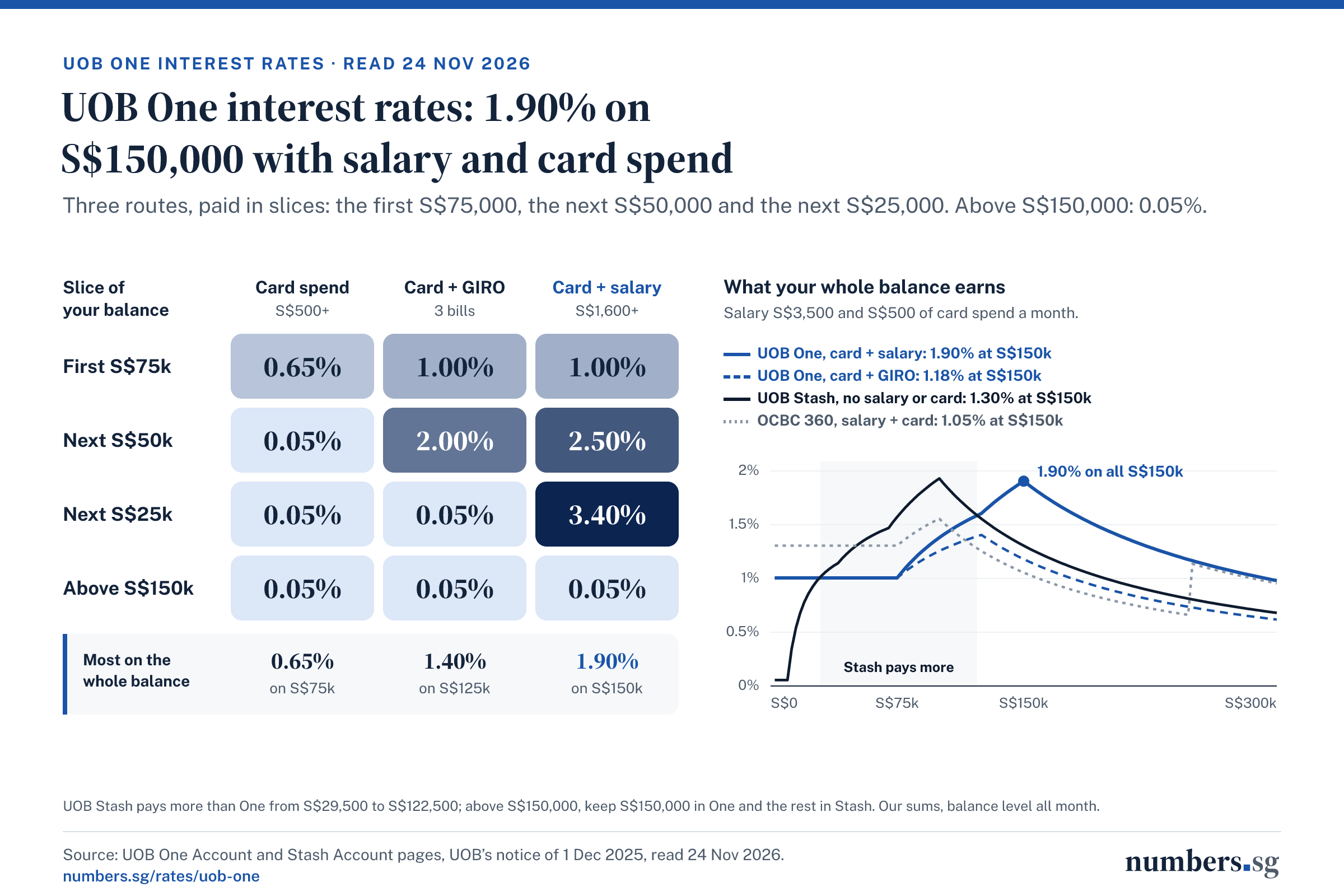
UOB One interest rates
UOB One pays one of three sets of rates, never a mix: S$500 of card spend alone, card spend plus 3 GIRO bills, or card spend plus a salary of at least S$1,600. Each set is paid in slices: one rate on the first S$75,000, another on the next S$50,000, another on the next S$25,000, and the base rate on the rest. The rates below already include the 0.05% base.
| Slice of the balance | S$500 card spend | Card + 3 GIRO bills | Card + salary S$1,600+ |
|---|---|---|---|
| First S$75,000 | 0.65% | 1.00% | 1.00% |
| Next S$50,000 | 0.05% | 2.00% | 2.50% |
| Next S$25,000 | 0.05% | 0.05% | 3.40% |
| Above S$150,000 | 0.05% | 0.05% | 0.05% |
| Most a year | S$488 0.65% on S$75,000 | S$1,750 1.40% on S$125,000 | S$2,850 1.90% on S$150,000 |
Your route from the calculator: card spend + salary: 1.00% on your whole S$20,000 (its column is highlighted). Without S$500 of card spend, the whole balance earns 0.05%.
What your whole balance earns
UOB One’s best-paid money sits between S$125,000 and S$150,000, so the rate on all your money climbs until S$150,000 and then falls. Below S$75,000 it is flat at 1.00%, which is less than OCBC 360 and DBS Multiplier pay for the same person, and over most of that range less than UOB’s own Stash.
UOB One pays most at S$150,000: 1.90% on the whole balance, and 1.00% below S$75,000. UOB’s own Stash peaks higher, at 1.93% on S$100,000, with no salary or card
- UOB One, card + salary
- UOB One, card + GIRO
- UOB Stash, balance kept level
- OCBC 360, salary + card
- DBS Multiplier, salary + card
UOB One or UOB Stash?
UOB raised its Stash Account rates on 1 November 2026. Stash needs no salary and no card spend, only an average balance this month that is no lower than last month’s, and it pays its best rate, 3.00%, on the slice from S$70,000 to S$100,000. For a large range of balances it pays more than One, and above S$150,000 the best answer is often both: S$150,000 in One and the rest in Stash. The table shows where each wins; the calculator above works out your own split.
| Balance | All in One | All in Stash | Best split |
|---|---|---|---|
| S$30,000 | S$300 | S$305 | All in Stash: S$305 |
| S$50,000 | S$500 | S$645 | All in Stash: S$645 |
| S$75,000 | S$750 | S$1,175 | All in Stash: S$1,175 |
| S$100,000 | S$1,375 | S$1,925 | All in Stash: S$1,925 |
| S$125,000 | S$2,000 | S$1,938 | S$25,000 in One, S$100,000 in Stash: S$2,175 |
| S$150,000 | S$2,850 | S$1,950 | All in One: S$2,850 |
| S$200,000 | S$2,875 | S$1,975 | S$150,000 in One, S$50,000 in Stash: S$3,495 |
| S$250,000 | S$2,900 | S$2,000 | S$150,000 in One, S$100,000 in Stash: S$4,775 |
UOB One with a salary and S$500 of card spend; the best split is worked out exactly from both rate tables. UOB Stash pays 0.05% on the first S$10,000, then 1.50%, 1.90% and 3.00% on the next three slices of S$30,000, and 0.05% above S$100,000, if this month’s average balance is at least last month’s; read from UOB’s Stash page. The calculator above works out your own split.
UOB One versus OCBC 360, DBS Multiplier and the rest
The same balance, salary and spending, worked out at every bonus account we track. Change the calculator above and this table follows, including when you switch to OCBC’s rates from 1 January.
DBS Multiplier pays S$160 a year more than UOB One for these numbers. UOB One comes fifth of 10.
| Account | Rate on the whole balance | A year |
|---|---|---|
| DBS Multiplier | 1.80% | S$360 |
| OCBC 360 | 1.30% | S$260 |
| GXS Savings Pockets | 1.20% | S$240 |
| Mari Savings Account | 1.08% | S$216 |
| UOB One | 1.00% | S$200 |
| CIMB FastSaver | 1.00% | S$200 |
| Standard Chartered Bonus$aver | 0.95% | S$190 |
| UOB Stash | 0.78% | S$155 |
| Bank of China SmartSaver | 0.60% | S$120 |
| Trust Flex plan | 0.60% | S$120 |
Changes with the calculator above. Each row assumes your salary and card spend go to that bank, your 3 GIRO bills too if you ticked them, and a balance that grows by S$500 a month only if you ticked it. UOB’s S$5 fee under S$1,000 is counted. Rules from each bank’s own page, read 23 Nov 2026; rank them all with more options, or see the OCBC 360 and DBS Multiplier calculators.
S$500 for the interest is not S$600 for the card cashback
The account and the UOB One Card run on different rules. The account needs S$500 posted in the calendar month on any eligible UOB card. The card’s own cashback needs at least S$600 and 10 purchases in every statement month of a quarter, on the One Card itself. So S$500 a month gets you the bonus interest and no cashback.
At S$500 a month: the bonus interest, but not the One Card’s cashback.
| Spend a month | What it gets you | Counted | At your spend |
|---|---|---|---|
| S$500+ | Bonus interest on the One Account | Any eligible UOB card, calendar month | Yes |
| S$600+ | S$60 cashback a quarter on the UOB One Card (S$240 a year) | UOB One Card only, 10+ purchases, every statement month of the quarter | No |
| S$1,000+ | S$100 cashback a quarter on the UOB One Card (S$400 a year) | UOB One Card only, 10+ purchases, every statement month of the quarter | No |
| S$2,000+ | S$200 cashback a quarter on the UOB One Card (S$800 a year) | UOB One Card only, 10+ purchases, every statement month of the quarter | No |
- Cards that count for the interest: UOB One Card, UOB Lady’s Card (all types), UOB EVOL Card and Lazada-UOB Card; and the UOB One Debit (Visa or Mastercard), UOB Lady’s Debit Card and UOB Mighty FX Debit Card. They must be in the name of the account’s primary holder.
- Counted: retail spend in Singapore and overseas, recurring bill payments charged to the card (insurance premiums included), and spend on the primary holder’s supplementary cards.
- Not counted: instalment plans and SmartPay, cash advances and transfers, bill payments at AXS, SAM or NETS machines, NETS and ATM transactions, UOB’s own fees, EZ-Link and transit top-ups, CardUp, iPaymy, AMAZE, RWS levy, brokers and remittances, and payments to schools, hospitals, charities, religious and political groups, car parks, property agents for rent, gambling, tax and government.
- Which month: counted by the date it posts to your card statement, so a purchase on the 30th that posts on the 2nd counts for the next month.
No salary? The GIRO route
If you are self-employed, retired or paid without a SALA marking, three GIRO bills a month plus S$500 of card spend gets you the middle route: 1.00% on the first S$75,000 and 2.00% on the next S$50,000. Nothing above S$125,000 earns a bonus on this route. For the same person, UOB Stash often pays more.
| Balance | UOB One, card + GIRO | UOB Stash | OCBC 360, card + Save |
|---|---|---|---|
| S$50,000 | S$500 1.00% | S$645 1.29% | S$400 0.80% |
| S$100,000 | S$1,250 1.25% | S$1,925 1.93% | S$950 0.95% |
| S$125,000 | S$1,750 1.40% | S$1,938 1.55% | S$963 0.77% |
| S$150,000 | S$1,763 1.18% | S$1,950 1.30% | S$975 0.65% |
UOB One with S$500 of card spend and 3 GIRO bills a month. UOB Stash needs only an average balance no lower than last month’s. OCBC 360 with S$500 of card spend and a balance that grows by S$500 every month, at today’s rates.
GIRO bills that count are debits to billing organisations, such as:
- IRAS (income tax)
- HDB (loan, conservancy)
- SP Services (utilities)
- Singtel, StarHub and M1
- Geneco and Pacific Light
- Insurers such as Prudential
- Your UOB credit card bill by GIRO
Not counted: bill payments made in internet banking, the app or at an ATM, bills charged to a card (those count as card spend instead), a GIRO that is set up but not yet debited, and transfers to your own accounts.
UOB One, T-bill or fixed deposit?
UOB One lets you take money out any day, but pays its bonus only on the first S$150,000 and only in months you qualify. Money you won’t need for six months or more can earn more elsewhere.
| Where | Rate a year | The catch |
|---|---|---|
| UOB One, card + salary | 1.00% on S$50,0001.90% on S$150,000 | Any day’s access; bonus month by month; 0.05% above S$150,000 |
| UOB One, card + GIRO | 1.00% on S$50,0001.18% on S$150,000 | Any day’s access; bonus month by month; 0.05% above S$125,000 |
| 6-month T-bill | 2.07% | Auction of 19 Nov 2026; S$1,000 steps, held 6 months, no cap |
| Best fixed deposit, 6 to 12 months | 2.30% | CIMB, 12 months; locked in |
| Singapore Savings Bond, first year | 1.83% | SBDEC26; S$2 to apply, out in about a month |
T-bill, fixed deposit and bond rates come from our own pages, read from MAS and the banks every day. Where to put your cash compares them for your amount and time, and UOB’s own fixed deposits have their own page.
What counts as salary
UOB goes by how the payment is marked, not by who you are. A salary from your employer marked SALA (or PAYNOW SALA) counts; a salary paid by a person, such as a sole proprietor paying from a personal account, doesn’t, UOB’s terms say. If yours can’t be marked SALA, UOB itself suggests the GIRO route.
| Paid by | What UOB looks for |
|---|---|
| GIRO | Transaction reference SALA |
| FAST | Transaction reference SALA |
| PayNow | Transaction reference PAYNOW SALA |
Not counted: cash or cheque deposits, transfers from your own or anyone’s personal account, overseas remittances, and a salary that lands outside the calendar month. The salary must be at least S$1,600 in the calendar month, in one credit or several.
Why a bonus didn’t come
- Card spend posted in the next month. UOB counts spend by the date it posts to your statement, not the date you paid. Spend in the last days of a month can fall into the next one.
- Spend that doesn’t count. Bills at AXS or SAM, transit top-ups, CardUp or iPaymy, instalments, and payments to schools, hospitals and government don’t count. Refunds and reversals in the month come off.
- A GIRO that hasn’t been debited yet. Setting up a GIRO arrangement doesn’t count; three actual debits in the calendar month do. Bills paid in the app or by card don’t count as GIRO.
- A salary without the marking. A transfer from your own account at another bank, or from a person, isn’t a salary to UOB.
- Average, not month-end. The bonus is paid on the month’s average balance: each day’s closing balance added up, divided by the days in the month. Money that arrives on the 25th counts for only a few days.
- The card is someone else’s. Only cards issued to the account’s primary holder count, with their supplementary cards.
Base interest is credited at the end of each month and the bonus at the beginning of the next, so the bonus for November arrives in early December.
Joint accounts and couples
A One Account can be joint, operated by either holder alone. Each person can hold only one One Account, sole or joint; if you hold two, UOB pays the bonus on only one and may close the other. Card spend counts only from the primary holder’s cards (and their supplementary cards). UOB’s terms don’t say whether a second holder’s salary counts, so ask UOB before relying on it.
UOB’s own figures, checked
All 12 of the figures UOB publishes come out the same through this page’s sums: the three “maximum effective interest rate” lines on UOB’s page, and the nine yearly amounts in UOB’s notice of the rates from 1 December 2025.
| UOB’s figure | UOB says | This calculator |
|---|---|---|
| Most on the whole balance, card spend only, on S$75,000 | 0.65% | 0.65% ✓ |
| Most on the whole balance, card spend + 3 GIRO bills, on S$125,000 | 1.40% | 1.40% ✓ |
| Most on the whole balance, card spend + salary, on S$150,000 | 1.90% | 1.90% ✓ |
| A year on S$75,000, card spend only | S$487.50 | S$487.50 ✓ |
| A year on S$75,000, card spend + 3 GIRO bills | S$750.00 | S$750.00 ✓ |
| A year on S$75,000, card spend + salary | S$750.00 | S$750.00 ✓ |
| A year on S$125,000, card spend only | S$512.50 | S$512.50 ✓ |
| A year on S$125,000, card spend + 3 GIRO bills | S$1,750.00 | S$1,750.00 ✓ |
| A year on S$125,000, card spend + salary | S$2,000.00 | S$2,000.00 ✓ |
| A year on S$150,000, card spend only | S$525.00 | S$525.00 ✓ |
| A year on S$150,000, card spend + 3 GIRO bills | S$1,762.50 | S$1,762.50 ✓ |
| A year on S$150,000, card spend + salary | S$2,850.00 | S$2,850.00 ✓ |
UOB One rates over the years
UOB has cut the One Account three times in seven months: from 4.00% to 3.30% on 1 May 2025, 2.50% on 1 Sep 2025 and 1.90% on 1 Dec 2025, each time “to align with long-term interest rate environment expectations”. The table goes back to 2017, from UOB’s own notices and copies of its page kept by the Internet Archive.
| From | Top rate | Bonus up to | Slices, top route | What changed |
|---|---|---|---|---|
| By Jul 2017 | 2.43% | S$50,000 | 1.50% to 3.33% | Bonus on the first S$50,000 in three slices; the salary had to be S$2,000, or 3 GIRO bills. Archived page |
| By Aug 2019 | 2.44% | S$75,000 | 1.85% to 3.88% | Five slices of S$15,000, bonus on the first S$75,000. Archived page |
| By Feb 2021 | 1.00% | S$75,000 | to 2.50% | Every slice cut, most likely in 2020 (the archived 2020 copies are empty); card spend alone pays 0.25%. Archived page |
| By Jan 2022 | 1.00% | S$75,000 | to 2.50% | The salary needed fell to S$1,600. Archived page |
| By Sep 2022 | 2.14% | S$100,000 | 1.40% to 3.60% | A sixth slice to S$100,000; salary now pays more than GIRO for the first time. Archived page |
| 1 Dec 2022 | 5.00% | S$100,000 | 3.85% to 7.80% | The peak: 7.80% on the slice from S$75,000 to S$100,000; card spend alone 0.65%. Archived page |
| 1 May 2024 | 4.00% | S$150,000 | 3.00% to 6.00% | Three slices of S$75,000, S$50,000 and S$25,000, bonus to S$150,000. UOB’s notice |
| 1 May 2025 | 3.30% | S$150,000 | 2.30% to 5.30% | Cut “to align with long-term interest rate environment expectations”, UOB’s notice said. UOB’s notice |
| 1 Sep 2025 | 2.50% | S$150,000 | 1.50% to 4.50% | Cut again, for the same reason. UOB’s notice |
| 1 Dec 2025 | 1.90% | S$150,000 | 1.00% to 3.40% | Cut a third time in seven months; today’s rates. UOB’s notice |
Dates with a day come from UOB’s own notice or page; “By” dates are the first archived copy that shows the change, so it may have happened earlier. Top rate is UOB’s own maximum on the whole balance at the cap, with a salary (before late 2022, with a salary or GIRO bills). The archived 2020 copies are empty, so a change that year may be missing.
Offers running now
Separate from the rates above, and each ends on the date shown. They drop off this page by themselves when they end.
- Open a UOB One Account online and add S$10,000 of fresh funds, kept until the end of the next month: S$150 if you are new to UOB deposits, S$50 if not. First 250 of each a week. Apply by 31 Dec 2026. UOB’s page · terms
- SalaryPlus: S$180 for crediting a salary of S$1,600 or more, S$50 for crediting CDP dividends and S$30 for a GIRO bill, if you had none of these at UOB from April to September 2026. Register first. Register by 31 Dec 2026. UOB’s page · terms
- Festive Savings: up to S$800 (S$1,000 if new to UOB deposits) for S$20,000 or more in fresh funds, which you can’t withdraw for about 7 months. Register first. Register by 31 Dec 2026. UOB’s page · terms
- Bill & Tax Super Saver: up to S$600 in cash rebates for paying income tax and monthly bills by GIRO from UOB. No registration. Ends 31 Mar 2027. UOB’s page · terms
Singapore interest rates 29 pages
- Best savings accounts, ranked for you
- New · 24 NovDBS Multiplier interest rate calculator
- OCBC 360 interest rate calculator
- UOB fixed deposit rates
- Where to put your cashT-bills vs Savings Bonds vs fixed deposits vs CPF, on your amount
- T-bill rates and auction results6-month T-bill2.07% up 0.21 percentage points
- Savings Bond ratesSingapore Savings Bond, 10-year average2.39% down 0.06 percentage points
- SORA3-month compounded SORA1.38%
- Fixed deposit ratesHighest 12-month fixed deposit2.30%
Also: CPF interest rates · CPF contribution rates · CPF retirement sums · USD fixed deposit rates · Chocolate Finance rates · Money market funds and cash accounts · Government bonds · T-bill calculator · SSB calculator · T-bill auction calendar · OCBC fixed deposit rates · Maybank fixed deposit rates · DBS fixed deposit rates · CIMB fixed deposit rates · Hong Leong Finance fixed deposit rates · RHB fixed deposit rates · ICBC fixed deposit rates · Bank of China (BOC) fixed deposit rates this week · Standard Chartered fixed deposit rates
Questions people ask
What is the UOB One interest rate?
0.05% a year as a base. With S$500 of card spend and a salary it is 1.00% on the first S$75,000, 2.50% on the next S$50,000 and 3.40% on the next S$25,000: 1.90% on exactly S$150,000. The table above has all three routes; the calculator works out yours.
How is UOB One interest calculated?
Base interest is worked out daily on each day’s closing balance and credited at the end of the month. The bonus is worked out at the end of the month on the monthly average balance, slice by slice, and credited at the beginning of the next month. Miss a condition in a month and that month earns no bonus.
What is the minimum balance for UOB One? Why does UOB charge S$5?
You need S$1,000 to open it. If the average balance in a month falls below S$1,000, UOB charges S$5 for that month, waived for the first 6 months if you opened the account online. Closing it within 6 months of opening costs S$30.
Which is better, UOB One, OCBC 360 or DBS Multiplier?
For a salary and S$500 of card spend, DBS Multiplier pays more below about S$82,000 and OCBC 360 pays more below about S$107,500; UOB One pays more than both from S$107,500 up to S$150,000. UOB’s own Stash pays more than One on balances from about S$29,500 to S$122,500, with no salary or card spend. The comparison above works out every account for your own numbers.
Is UOB One still worth it?
For balances near S$150,000 with a salary, yes: 1.90% on the whole balance is more than the other bonus accounts on this page pay for the same habits. For smaller balances, UOB Stash or the other accounts usually pay more. Put in your numbers.
Do GIRO payments to my own account count?
No. Only GIRO debits to billing organisations count, such as IRAS, HDB, SP Services and telcos, debited in the calendar month. Payments you make in the app or at an ATM don’t count either.
Can I open more than one UOB One Account?
No. Each person can hold only one, sole or joint. If you hold more than one, UOB pays the bonus on only one and may close the others.
Is the interest taxed?
No, for individuals: IRAS lists interest on deposits with approved banks in Singapore as not taxable, and UOB is one. Check IRAS’s page on interest if the deposit is part of a business or partnership.
Is my money in UOB One insured?
Singapore-dollar deposits are insured by SDIC up to S$100,000 per depositor at each member bank, across all your accounts there, UOB Stash included. UOB is a member bank.
How we work it out
- Rates and rules: UOB’s One Account page, UOB’s notice of the rates from 1 December 2025, UOB’s FAQs on salary credit, card spend and GIRO, UOB’s account terms (clause 40, One Account) and the One Card terms, all read 24 Nov 2026. We read them again when UOB announces a change, and at least once a month.
- Interest: each slice at its own rate on the month’s average balance, over the actual days in the month and a 365-day year, as UOB’s notice works its yearly figures. We assume the balance stays the same all month; your real interest moves with it. UOB doesn’t say how it rounds, so the cents may differ.
- UOB Stash: rates from UOB’s Stash page (from 1 Nov 2026). The best split tries every point where either account’s rate changes, so it is exact for a balance that stays level.
- Next steps: each change is worked out with your own numbers and ranked by what it adds in a month. We don’t suggest getting a card for the interest alone.
- Other banks: their rules come from our savings account ranking, read from each bank’s own page. T-bill, fixed deposit and bond rates come from our own pages, read every day.
- Every answer is worked out in your browser and again on our server, and the two are checked against each other on thousands of sets of inputs, today and after OCBC’s promotion ends.
- We haven’t held a One Account or checked these sums against a UOB statement. If yours differs, tell us.
- UOB doesn’t pay us, and no link on this page is a referral or affiliate link. This is not advice on where to keep your money. See our disclaimer and how we get our numbers.
New: a UOB One interest rate calculator. Put in your balance, salary, GIRO bills and card spend, and it finds which of UOB’s three routes you are on, works out each slice (the first S$75,000, the next S$50,000 and the next S$25,000) the way UOB’s terms describe, and ranks the change that would add most. It also works out the best split between UOB One and UOB’s own Stash Account, which pays more than One on many balances since its 1 Nov 2026 rise, the balance where One starts to beat OCBC 360 and DBS Multiplier, all 12 figures UOB publishes (each matches), and UOB One’s rates back to 2017.