
Rates · Bank rules
DBS Multiplier interest rate calculator
Your DBS Multiplier rate and interest from your income, spending and balance, worked out from DBS’s own rate table the way DBS does it.
DBS Multiplier top rate · read 24 Nov 2026
4.10% a year
On the first S$100,000 only
Needs your income plus spend, insurance and investments with DBS, S$30,000 or more a month in all. With income and card spend alone it is 1.80% on the first S$50,000.
What each route pays, % a year
- Income + 3 categoriesS$30,000+ a month4.10%
- Income + 3 categoriesS$500+ a month2.40%
- Income + 2 categoriesS$500+ a month2.10%
- Income + 1 categoryS$500+, first S$50k1.80%
- Aged 18 to 29any spend, first S$50k1.50%
- Nothing metbase rate0.05%
From DBS’s rate table. Bars start at 0%. Money above the cap, and in any month you miss, earns 0.05%.
Salary and card spend, S$100,000
S$923
a year: 0.92% on the whole
Income + 1 category pays 1.80% on the first S$50,000 only.
Add a S$100 Invest-Saver
+S$1,175
a year on the same S$100,000
A second category lifts the rate to 2.10% and the cap to S$100,000.
The same at S$200,000
1.07%
on the whole balance
Everything above S$100,000 earns 0.05%.
Work out your rate
Put in what goes through DBS or POSB in a normal month. The calculator finds your row in DBS’s rate table, works out the interest the way DBS does, and shows the change that would add the most.
DBS Multiplier interest rates
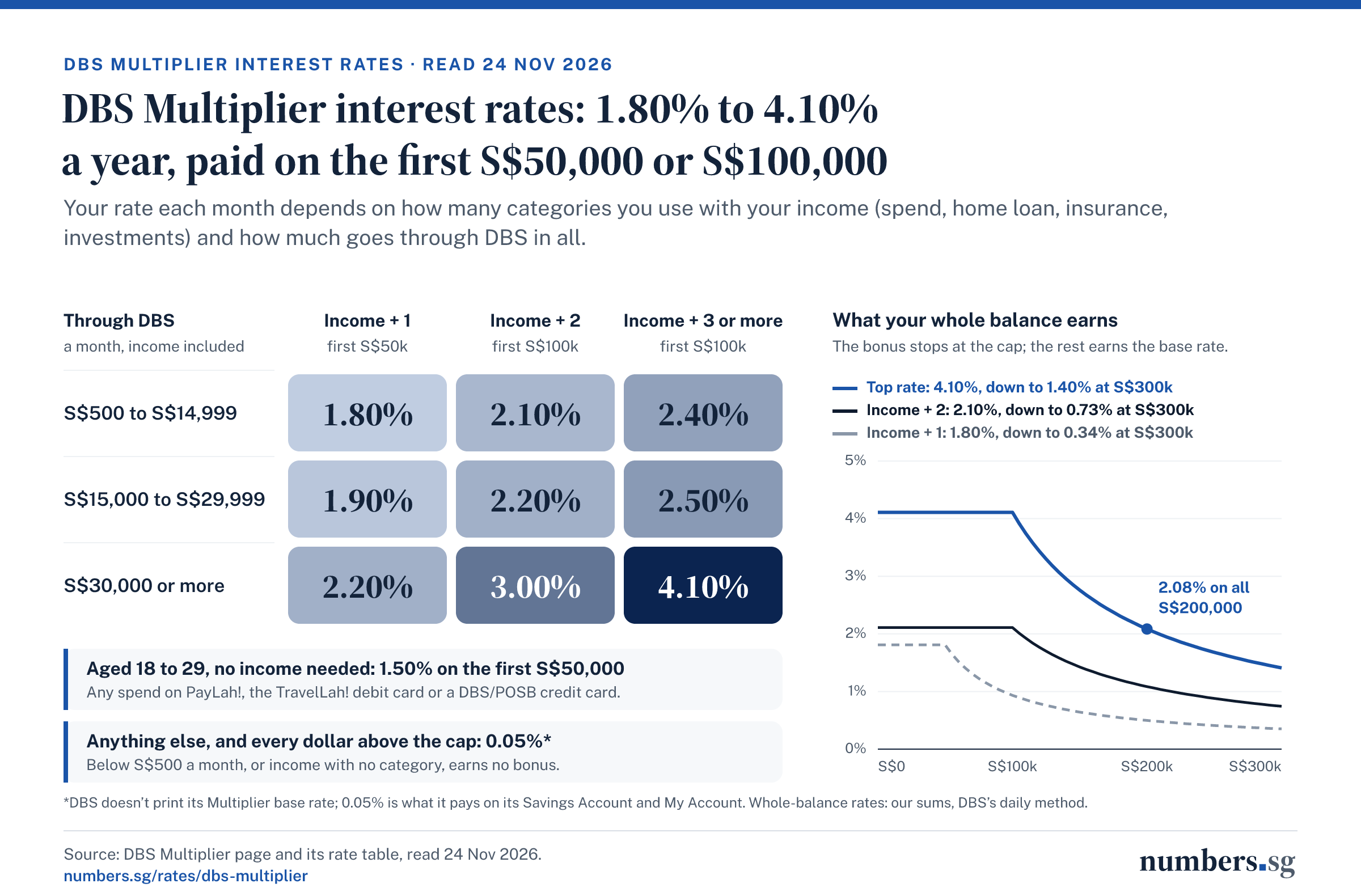
Two things set your rate each month: how many categories you use besides your income (spend, home loan, insurance, investments), and how much goes through DBS in all, income included. One category pays on the first S$50,000; two or more pay on the first S$100,000.
| Income plus spend, home loan, insurance and investments, a month | Income + 1 category | Income + 2 | Income + 3 or more |
|---|---|---|---|
| S$500 to S$14,999 | 1.80% | 2.10% | 2.40% |
| S$15,000 to S$29,999 | 1.90% | 2.20% | 2.50% |
| S$30,000 or more | 2.20% | 3.00% | 4.10% |
| Paid on the first | S$50,000 | S$100,000 | S$100,000 |
- Aged 18 to 29, no income needed: 1.50% on the first S$50,000 with any spend on PayLah!, the TravelLah! debit card or a DBS/POSB credit card.
- Anything else, and every dollar above the cap: 0.05%. DBS says base interest applies but doesn’t print the figure for Multiplier; 0.05% is what DBS pays on its Savings Account and My Account, read 24 Nov 2026.
Your rate from the calculator: 2.10% on the first S$100,000 (highlighted).
What your whole balance earns
DBS quotes the rate on the capped part. On a bigger balance the rest earns the base rate, so the rate on all your money falls the more you keep there.
At 2.10%, S$200,000 earns 1.07% on the whole: the money above S$100,000 earns 0.05%
- Income + 3, S$30k+ (4.10% on the first S$100,000)
- Income + 2 (2.10% on the first S$100,000)
- Income + 1 (1.80% on the first S$50,000)
- 6-month T-bill, auction of 19 Nov 2026
DBS Multiplier versus OCBC 360, UOB One and the rest
The same balance, income and spending, worked out at every bonus savings account we track. Change the calculator above and this table follows.
Bank of China SmartSaver pays S$449 a year more than DBS Multiplier for these numbers. DBS comes third of 10.
| Account | Rate on the whole balance | A year |
|---|---|---|
| Bank of China SmartSaver | 3.60% | S$1,080 |
| Standard Chartered Bonus$aver | 2.45% | S$735 |
| DBS Multiplier | 2.10% | S$631 |
| OCBC 360 | 2.05% | S$615 |
| Trust Flex plan | 1.30% | S$390 |
| GXS Savings Pockets | 1.20% | S$360 |
| Mari Savings Account | 1.08% | S$324 |
| UOB Stash | 1.02% | S$305 |
| CIMB FastSaver | 1.01% | S$304 |
| UOB One | 0.05% | S$15 |
Changes with the calculator above. Each row assumes your income and card spend go to that bank, no GIRO bills, a balance kept level and, where you put insurance or investments, that you’d buy them at that bank instead. Rules from each bank’s own page, read 23 Nov 2026; rank them all with more options.
Multiplier, T-bill or fixed deposit?
Multiplier lets you take money out any day, but pays its bonus only on the capped part and only in months you qualify. Money you won’t need for six months or more can earn more elsewhere.
| Where | Rate a year | The catch |
|---|---|---|
| Multiplier, income + 1 category | 1.80% | On the first S$50,000 only; any day’s access; set month by month by what goes through DBS |
| Multiplier, income + 2 categories | 2.10% | On the first S$100,000 only; any day’s access; set month by month by what goes through DBS |
| Multiplier, the top rate | 4.10% | On the first S$100,000 only; any day’s access; set month by month by what goes through DBS (S$30,000+ a month) |
| 6-month T-bill | 2.07% | Auction of 19 Nov 2026; S$1,000 steps, held 6 months, no cap |
| Best fixed deposit, 6 to 12 months | 2.30% | CIMB, 12 months; locked in |
| Singapore Savings Bond, first year | 1.83% | SBDEC26; S$2 to apply, out in about a month |
T-bill, fixed deposit and bond rates come from our own pages, read from MAS and the banks every day. Where to put your cash compares them for your amount and time.
What counts as income and as a category
You don’t need a salary. DBS counts dividends, CPF payouts (CPF LIFE included) and SRS withdrawals too, if they reach DBS or POSB the right way. DBS says income is recognised within 2 business days.
| Income | How DBS spots it | Into |
|---|---|---|
| Salary, bonus or commission | GIRO, FAST or PayNow with code SAL or PAY, or a description saying SALARY, PAYROLL, COMMISSION or BONUS | Any DBS/POSB Singapore-dollar account |
| Dividends | Code CDP or NDIV, or a description saying DIVIDEND, from CDP, DBS Vickers, DBS Online Equity Trading, DBS unit trusts, Invest-Saver or online funds | Any DBS/POSB Singapore-dollar account, a DBS Wealth Management Account, your SRS account or your CPF Investment Account |
| CPF payouts (CPF LIFE and others) | Code CPF, or a description saying CPF | Any DBS/POSB account |
| SRS withdrawals | Code SRS, or a description saying SRS | Any DBS/POSB account |
| NS allowance | Counted as income in DBS’s own example (William, S$755) | Any DBS/POSB account |
The categories, in DBS’s words, shortened:
- Spend: Retail spend and cash advances on any DBS/POSB personal credit card, posted in the month (refunds come off; a supplementary card counts for the main cardholder); PayLah! payments to shops, Scan & Pay and bill payments; the TravelLah! debit card for ages 29 and below.
- Home loan: The month’s instalment due on a DBS/POSB home loan, cash and CPF together, new or existing. The first three joint borrowers each get the full instalment.
- Insurance: Manulife policies sold through DBS/POSB and bought after you open Multiplier. Counted from the 23rd of the month after the policy starts, for 12 months: a yearly premium ÷ 12, or a single premium ÷ 120.
- Investments: New unit trusts, bonds and structured products (not Savings Bonds or SGS), share buys through DBS Vickers or DBS Online Equity Trading, and digiPortfolio (S$1,000 or more a time). Invest-Saver and digiPortfolio monthly plans count for their first 12 months per fund or portfolio.
If you receive dividends through CDP, you can switch your direct crediting to DBS in your CDP account. See our CDP account guide, the DBS dividend page and the CPF LIFE payout calculator for what that income comes to.
Why your rate was lower this month
- Month-end timing. DBS says spending near the end of a month may be counted in the next month. PayLah! and income take up to 2 business days to be recognised.
- Refunds. Card refunds and reversals come off your eligible spend.
- A salary without the right code. DBS looks for SAL or PAY (or a description saying SALARY, PAYROLL, COMMISSION or BONUS). A transfer from your own account at another bank is not a salary.
- Twelve months are up. A Manulife policy and an Invest-Saver or digiPortfolio monthly plan count for 12 months; after that the category falls away unless you add another.
- Fewer categories, lower cap. Drop to one category and the cap falls from S$100,000 to S$50,000.
- Under S$3,000. Below an average daily balance of S$3,000, DBS charges S$5 a month unless you are 29 or younger.
To check, DBS says to open your Multiplier account in digibank and tap Bank & Earn: it shows the transactions counted and the rate you qualify for, as of 2 days ago. Bonus interest is paid by the 7th working day of the next month; base interest on the last day of each month.
Couples and joint accounts
In DBS’s own example, Rachel and Bryan each have a Multiplier account and credit their salaries of S$6,000 and S$5,000 into a joint account, so each account is recognised with S$11,000 of income. Their joint DBS home loan’s S$3,000 instalment counts for both: DBS gives the full instalment to each of the first three joint borrowers. Rachel adds S$5,000 of card spend and gets 2.2%; Bryan adds S$3,000 of card spend and S$1,000 of insurance, a third category, and gets 2.5%. Tap their rows below to load them.
DBS’s own examples, checked
All 6 of DBS’s worked examples come out at the rate and cap DBS gives. Tap a name to load it into the calculator. DBS doesn’t give the balances, so the calculator fills one in.
| DBS’s example | What goes through DBS in the month | What DBS says | This calculator |
|---|---|---|---|
| S$3,500 salary, S$200 card, S$100 Invest-Saver | S$3,800 across income + 2 categories: 2.1% on his first S$100,000 | 2.10% on S$100,000 ✓ | |
| S$11,000 joint salaries, S$5,000 card, S$3,000 home loan | S$19,000 across income + 2 categories: 2.2% on her first S$100,000 | 2.20% on S$100,000 ✓ | |
| S$11,000 joint salaries, S$3,000 card, S$1,000 insurance, S$3,000 home loan | S$18,000 across income + 3 categories: 2.5% on his first S$100,000 | 2.50% on S$100,000 ✓ | |
| S$755 NS allowance, S$100 PayLah! | S$855 across income + 1 category: 1.8% on the first S$50,000 | 1.80% on S$50,000 ✓ | |
| No income, S$100 PayLah! | S$100 of spend: 1.5% on her first S$50,000 | 1.50% on S$50,000 ✓ | |
| S$700 CPF LIFE payout, S$200 PayLah! | S$900 across income + 1 category: 1.80% on the first S$50,000 | 1.80% on S$50,000 ✓ |
DBS’s S$250 salary offer
A one-off cash reward for moving your salary to DBS or POSB. It is separate from the Multiplier rate, and it ends on the date below.
- S$250 cash for crediting a salary of S$1,600 or more (S$500 for an NSF allowance) by GIRO with code SAL or PAY for 4 months in a row, the first by 31 Jan 2027. Register first; limited to the first 5,000. Only if you credited no salary to DBS/POSB in the 3 calendar months before registering and got no DBS/POSB salary reward in the 12 months before. Paid by 30 Jun 2027. Register by 31 Dec 2026. DBS’s page · terms
Singapore interest rates 29 pages
- New · 24 NovOCBC 360 interest rate calculator
- Best savings accounts, ranked for you
- UOB One interest rate calculator
- Where to put your cashT-bills vs Savings Bonds vs fixed deposits vs CPF, on your amount
- T-bill rates and auction results6-month T-bill2.07% up 0.21 percentage points
- Fixed deposit ratesHighest 12-month fixed deposit2.30%
- Savings Bond ratesSingapore Savings Bond, 10-year average2.39% down 0.06 percentage points
- SORA3-month compounded SORA1.38%
- CPF interest ratesCPF Ordinary Account2.50%
Also: CPF contribution rates · CPF retirement sums · USD fixed deposit rates · Chocolate Finance rates · Money market funds and cash accounts · Government bonds · T-bill calculator · SSB calculator · T-bill auction calendar · UOB fixed deposit rates · OCBC fixed deposit rates · Maybank fixed deposit rates · DBS fixed deposit rates · CIMB fixed deposit rates · Hong Leong Finance fixed deposit rates · RHB fixed deposit rates · ICBC fixed deposit rates · Bank of China (BOC) fixed deposit rates this week · Standard Chartered fixed deposit rates
Questions people ask
How is DBS Multiplier interest calculated?
DBS adds up your income and eligible transactions for the whole month, which sets your rate. It then works out interest each day on your end-of-day Singapore-dollar balance: the bonus rate up to the cap, the base rate above it. Each day’s figure is rounded to 2 decimal places and the month’s days are added up. The calculator shows the sum.
Is DBS Multiplier worth it?
It depends on your balance and what already goes through DBS. With a salary and card spend it pays 1.80% on the first S$50,000; adding a second category (an S$100 Invest-Saver plan, say) lifts that to 2.10% on the first S$100,000. Other accounts can pay more for the same habits: compare them for your numbers.
Is DBS Multiplier free? What is the minimum balance?
There is no minimum to open it and no initial deposit. If your average daily balance falls below S$3,000, DBS charges S$5 a month, waived if you are 29 or younger.
Is DBS Multiplier or OCBC 360 better?
For the same balance, salary and spending, the comparison above works out both, and UOB One and the other bonus accounts too; the OCBC 360 and UOB One calculators show each bank’s own tiers in full. Which pays more changes with your balance and with how many of each bank’s conditions you meet.
How much money should I keep in DBS Multiplier?
The bonus is paid only up to S$50,000 with one category, or S$100,000 with two or more. Above that DBS pays the base rate, so the rate on your whole balance falls. Money above the cap usually earns more in a T-bill, fixed deposit or Savings Bond.
Can I convert my POSB or DBS account to Multiplier?
DBS says you can convert a personal DBS eAutoSave, eMulti-Currency or My Account (not a joint account) in digibank. Multiplier itself counts income credited to any DBS or POSB account, so a POSB salary account still counts.
Do I need a salary to earn bonus interest?
No. Dividends, CPF payouts and SRS withdrawals count as income, and if you are 18 to 29, any spend on PayLah!, the TravelLah! debit card or a DBS credit card earns 1.50% on the first S$50,000 with no income at all.
Is the interest taxed?
No, for individuals: IRAS lists interest on deposits with approved banks in Singapore as not taxable, and DBS is one. Check IRAS’s page on interest if the deposit is part of a business or partnership.
Is my money in Multiplier insured?
Singapore-dollar deposits are insured by SDIC up to S$100,000 per depositor at each member bank, and DBS and POSB count as one bank. Foreign-currency balances are not covered.
How we work it out
- Rates, caps and rules: DBS’s Multiplier page and its rate table, read 24 Nov 2026. We read it again when DBS announces a change, and at least once a month.
- Base rate: DBS’s Multiplier pages say money outside the bonus earns “base interest” but don’t give the figure. We use 0.05%, what DBS’s deposit rates page lists for its Savings Account and My Account, read 24 Nov 2026. Your statement shows the rate DBS actually paid.
- Interest: worked out the way DBS’s page describes (each balance level per day rounded to 4 decimal places, the day to 2), on a balance that stays the same all month and a 365-day year. Your real interest moves with your daily balance.
- Next steps: each change is worked out with your own numbers and ranked by what it adds in 30 days. We don’t suggest buying insurance or investments for the interest alone.
- Other banks: their rules come from our savings account ranking, read from each bank’s own page. T-bill, fixed deposit and bond rates come from our own pages, read every day.
- Every answer is worked out in your browser and again on our server, and the two are checked against each other on thousands of sets of inputs.
- DBS doesn’t pay us, and no link on this page is a referral or affiliate link. This is not advice on where to keep your money. See our disclaimer, how we get our numbers and corrections.
New: a DBS Multiplier interest rate calculator. Put in your balance, income and what goes through DBS, and it finds your cell in DBS’s rate table, works out the interest DBS’s way (day by day, to the cent), and ranks the change that would add most. It also shows what your whole balance earns once you pass the cap, the same numbers at 9 other bonus accounts, and DBS’s six worked examples, all six matching DBS’s rate and cap.