
Rates · Bank rules
OCBC 360 interest rate calculator
Your OCBC 360 rate and interest from your balance, salary, savings and card spend, worked out from OCBC’s own rate table, now and after the Save promotion ends.
OCBC 360 top rate · read 24 Nov 2026
4.70% a year
On exactly S$100,000, all five bonuses
Two of the five need you to buy insurance or an investment through OCBC. With a salary, a growing balance and S$500 of card spend it is 1.80% on the first S$75,000 and 3.40% on the next S$25,000.
Rate on S$100,000, % a year
- All five bonuseswith insurance and an investment; at S$30,000: 3.80%4.70%
- Salary, Save and Spendno purchase needed; at S$30,000: 1.80%2.20%
- Salary and Spendbalance not growing; at S$30,000: 1.30%1.55%
- Salary onlyat S$30,000: 1.05%1.30%
- No salary, adding S$500 a monthSave only; at S$30,000: 0.55%0.70%
Worked out from OCBC’s rate table, with the Save promotion that runs to 31 Dec 2026. Bars start at 0%. Money above S$100,000 earns 0.05%.
Salary, Save and card, S$30,000
S$540
a year: 1.80%
Below S$75,000 every dollar earns the lower tier, not OCBC’s headline rate.
From 1 Jan 2027
−S$250
a year on S$100,000
The Save promotion ends: the same habits drop from 2.20% to 1.95%.
The best-paid S$25,000
3.40%
from S$75,001 to S$100,000
With salary, Save and Spend. Above S$100,000 it drops to 0.05%.
Work out your rate
Put in your average balance and what you do in a normal month. The calculator adds up the bonuses you qualify for in OCBC’s two tiers, works out the interest the way OCBC’s terms describe, and shows the change that would add the most.
OCBC 360 interest rates
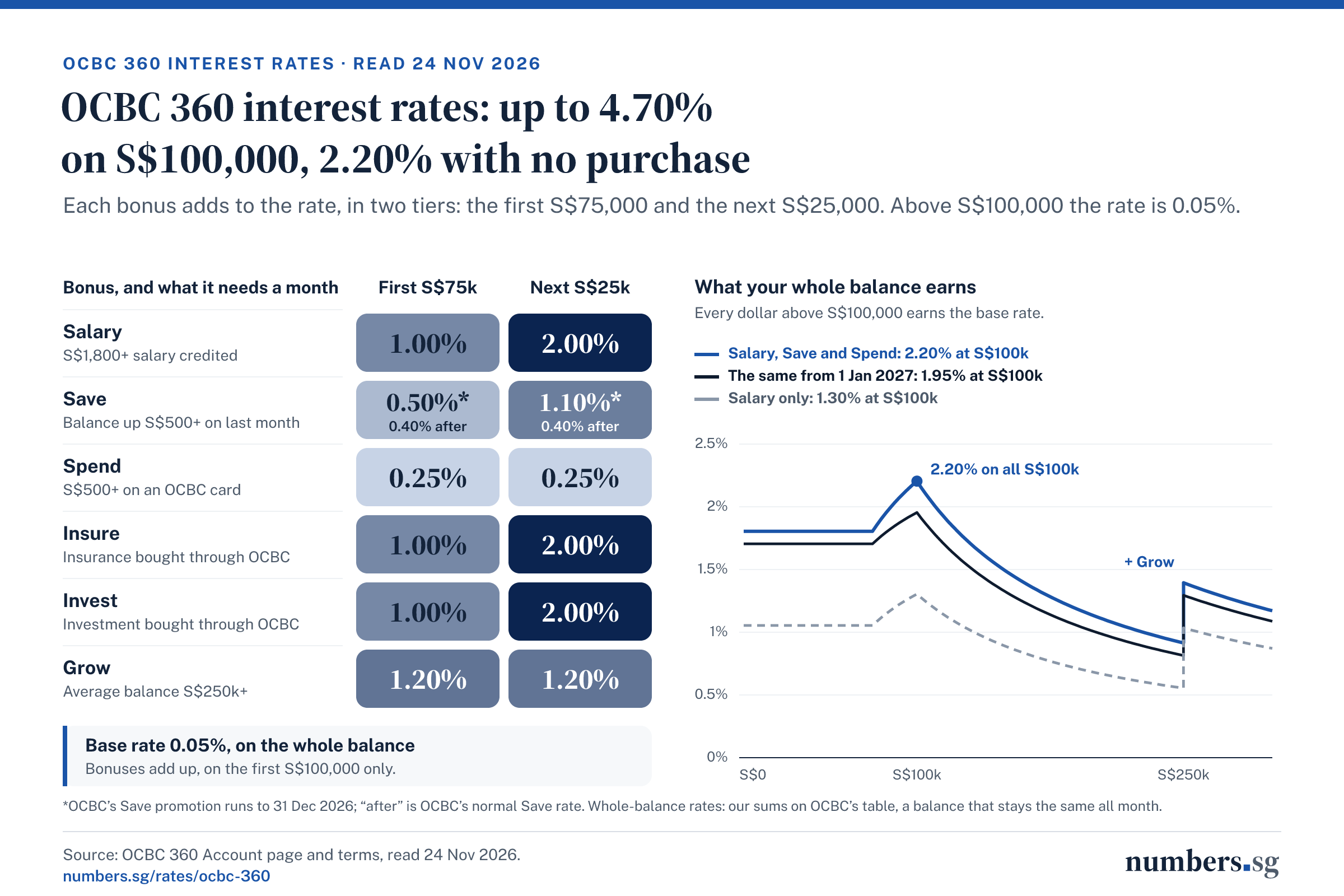
Each bonus you qualify for is added on top of the others, but only on the first S$100,000, and in two tiers: one rate on the first S$75,000 and a higher one on the next S$25,000. That is why OCBC’s headline rate is quoted on exactly S$100,000.
| Bonus | Needs, each month | First S$75,000 | Next S$25,000 |
|---|---|---|---|
| Salary | A salary of S$1,800+ by GIRO, FAST or PayNow | 1.00% | 2.00% |
| Save | Average balance up S$500+ on last month | 0.50% 0.40% from 1 Jan | 1.10% 0.40% from 1 Jan |
| Spend | S$500+ on an eligible OCBC card | 0.25% | 0.25% |
| Insure | Eligible insurance bought through OCBC (12 months) | 1.00% | 2.00% |
| Invest | Eligible investment bought through OCBC (12 months) | 1.00% | 2.00% |
| Grow | Average balance of S$250,000+ | 1.20% | 1.20% |
| Base | Nothing; on the whole balance | 0.05% | 0.05% |
Your rate from the calculator: 1.80% on the first S$75,000, 3.40% on the next S$25,000 (bonuses you get are highlighted). Above S$100,000, 0.05%.
What your whole balance earns
Below S$75,000 every dollar earns the lower tier. The rate on all your money peaks at S$100,000, then falls, because everything above it earns the base rate. At S$250,000 the Grow bonus kicks in and lifts it again.
With salary, Save and Spend, the rate on all your money peaks at 2.20% on S$100,000, and is 1.80% anywhere below S$75,000
- Salary, Save and Spend
- The same from 1 Jan 2027
- Salary only
- 6-month T-bill, auction of 19 Nov 2026
OCBC 360 versus DBS Multiplier, UOB One and the rest
The same balance, salary and spending, worked out at every bonus savings account we track. Change the calculator above and this table follows, including when you switch to the rates from 1 January.
For these numbers OCBC 360 and DBS Multiplier pay the same, S$360 a year, the most of the 10 accounts.
| Account | Rate on the whole balance | A year |
|---|---|---|
| OCBC 360 | 1.80% | S$360 |
| DBS Multiplier | 1.80% | S$360 |
| GXS Savings Pockets | 1.20% | S$240 |
| Mari Savings Account | 1.08% | S$216 |
| CIMB FastSaver | 1.00% | S$200 |
| UOB One | 1.00% | S$200 |
| Standard Chartered Bonus$aver | 0.95% | S$190 |
| UOB Stash | 0.78% | S$155 |
| Bank of China SmartSaver | 0.60% | S$120 |
| Trust Flex plan | 0.60% | S$120 |
Changes with the calculator above. Each row assumes your salary and card spend go to that bank, no GIRO bills, a balance that grows by S$500 a month if you ticked Save, and, where you ticked insurance or investments, that you’d qualify at that bank too. OCBC’s S$2 fee under S$3,000 is counted, as after the first year. Rules from each bank’s own page, read 23 Nov 2026; rank them all with more options, or see the DBS Multiplier calculator.
Is Insure or Invest worth it for the interest?
These two bonuses are what take OCBC’s headline from about 2% to over 4%. Each needs a purchase through OCBC, and each pays for 12 months from when the purchase takes effect (after the free-look period, or 14 days, whichever is later). The table sets what each adds at your balance against what it asks you to put in.
At S$20,000 in the account, Insure or Invest adds S$200 over the 12 months.
| Bought through OCBC | At least | Bonus over 12 months |
|---|---|---|
| Insurance, regular premium: protection, legacy or investment-linked (GREAT Term 2, GREAT Life Multiplier and others) | S$2,000 a year in premiums | S$200 |
| Insurance, regular premium: endowment or retirement (MaxEndowment, GREAT Retire Income and others) | S$4,000 a year in premiums | S$200 |
| Insurance, single premium (PremierLife, Prestige Wealth Legacy and others) | S$20,000 once | S$200 |
| Unit trusts (not money market funds, not a monthly OCBC Momentum plan, not funds moved in from another bank) | S$20,000 once | S$200 |
| Structured deposits | S$20,000 once | S$200 |
| Bonds and structured products | S$200,000 once | S$200 |
Compare the bonus with the product’s own costs, such as sales charges, fees and what a policy is worth if you stop early, which are in its product summary. OCBC says the Invest bonus keeps paying for the 12 months if you sell the investment or it matures, but cancelled purchases don’t count and it can claw back the bonus. A second purchase restarts the 12 months; overlapping ones don’t stack. We don’t sell insurance or investments, and this isn’t advice on whether to buy them.
Keeping the Save bonus
OCBC compares this month’s average daily balance with last month’s only. In OCBC’s own example a balance that falls from S$10,000 to S$9,000 misses the bonus in that month, then qualifies again at S$9,500. So the bonus doesn’t need a record high, but every month it needs S$500 more than the month before.
Starting from S$20,000, a year of Save bonuses takes S$6,000 more in the account and pays about S$95 in all at the 0.40% rate that applies from 1 Jan 2027.
| Month | Average balance needed | Save bonus that month |
|---|---|---|
| 1 | S$20,500 | S$6.96 |
| 3 | S$21,500 | S$7.30 |
| 6 | S$23,000 | S$7.81 |
| 12 | S$26,000 | S$8.83 |
OCBC 360, T-bill or fixed deposit?
360 lets you take money out any day, but pays its bonuses only on the first S$100,000 and only in months you qualify. Money you won’t need for six months or more can earn more elsewhere.
| Where | Rate a year | The catch |
|---|---|---|
| OCBC 360, salary, Save and Spend | 1.80% on S$50,0002.20% on S$100,000 | Any day’s access; bonuses month by month; 0.05% above S$100,000 |
| OCBC 360, salary only | 1.05% on S$50,0001.30% on S$100,000 | Any day’s access; bonuses month by month; 0.05% above S$100,000 |
| 6-month T-bill | 2.07% | Auction of 19 Nov 2026; S$1,000 steps, held 6 months, no cap |
| Best fixed deposit, 6 to 12 months | 2.30% | CIMB, 12 months; locked in |
| Singapore Savings Bond, first year | 1.83% | SBDEC26; S$2 to apply, out in about a month |
T-bill, fixed deposit and bond rates come from our own pages, read from MAS and the banks every day. Where to put your cash compares them for your amount and time.
What counts as salary and as card spend
The Salary bonus needs at least S$1,800 a month from your employer, in one credit or several. OCBC goes by how the payment is marked, and says it may ask for proof that it is your salary. Cheques, cash deposits and ordinary transfers don’t count, and nor do CPF payouts, dividends or SRS withdrawals, which DBS Multiplier does count.
| Paid by | What OCBC looks for |
|---|---|
| GIRO, or PayNow via GIRO | Description GIRO-SALARY |
| FAST, or PayNow via FAST | Code SAL, or description SALARY, SALA or SAL |
- Card spend: retail spend posted in the month on the OCBC 365, OCBC INFINITY Cashback, OCBC Rewards, OCBC 90°N (Mastercard or Visa) and OCBC NXT cards, refunds taken off; a supplementary card counts for the main cardholder. Not counted: annual fees, insurance premiums, Cash-On-Instalment and instalment plans, income tax, bills paid through internet banking or AXS, interest and late charges, cash advances, balance transfers, PayLite, transit top-ups, and merchants on OCBC’s exclusion lists.
If you are self-employed or retired, you can’t get the Salary bonus. Save, Spend and, from S$250,000, Grow need no salary. The DBS Multiplier calculator shows what dividends or CPF payouts earn there.
Why a bonus didn’t come
- Save, by one day. OCBC says a FAST or PayNow transfer made at a weekend, on a public holiday or after the cut-off time can be valued the next business day. If that is the 1st of the next month, it counts towards the wrong month’s average.
- Average, not month-end. Save and Grow look at the average daily balance (each day’s balance added up, divided by the days in the month), not what is there on the last day.
- A salary without the right marking. OCBC looks for GIRO-SALARY, or SAL, SALARY or SALA on a FAST or PayNow credit. A transfer from your own account elsewhere is not a salary.
- Card spend that doesn’t count. Bills paid through internet banking or AXS, insurance premiums, instalment plans and transit top-ups don’t count, and refunds come off. Spend is counted by posting date, so a purchase on the 30th can land in the next month.
- Twelve months are up. Insure and Invest stop 12 months after the purchase takes effect.
- Paid later than you think. Bonuses are worked out at the end of the month and credited by the 7th business day of the next month. Close the account before then and OCBC keeps the last month’s bonus.
Each bonus shows separately on your statement and in the app, as 360 SALARY BONUS, 360 SAVE BONUS, 360 CC SPEND BONUS, 360 INSURE BONUS, 360 INVEST BONUS and 360 GROW BONUS.
Joint accounts and couples
OCBC lets one 360 Account per person be held as the primary holder, and it can be joint. In a joint account OCBC adds up the salaries every holder credits towards the S$1,800. Card spend counts only from the primary holder’s own eligible OCBC cards (supplementary cards included).
OCBC’s own figures, checked
All 14 of the figures OCBC publishes come out the same through this page’s sums. The yearly amounts are from OCBC’s FAQ, on the normal Save rate; the rates on S$100,000 are OCBC’s “effective interest rate” lines, base rate included.
| OCBC’s figure | OCBC says | This calculator |
|---|---|---|
| Salary bonus, most a year | S$1,250 | S$1,250 ✓ |
| Save bonus, most a year | S$400 | S$400 ✓ |
| Spend bonus, most a year | S$250 | S$250 ✓ |
| Insure bonus, most a year | S$1,250 | S$1,250 ✓ |
| Invest bonus, most a year | S$1,250 | S$1,250 ✓ |
| Grow bonus, most a year | S$1,200 | S$1,200 ✓ |
| Salary + Save on S$100,000 | 1.70% | 1.70% ✓ |
| Salary + Save on S$100,000, with the Save promotion | 1.95% | 1.95% ✓ |
| + Spend on S$100,000 | 1.95% | 1.95% ✓ |
| + Spend on S$100,000, with the Save promotion | 2.20% | 2.20% ✓ |
| + Insure or Invest on S$100,000 | 3.20% | 3.20% ✓ |
| + Insure or Invest on S$100,000, with the Save promotion | 3.45% | 3.45% ✓ |
| + Insure and Invest on S$100,000 | 4.45% | 4.45% ✓ |
| + Insure and Invest on S$100,000, with the Save promotion | 4.70% | 4.70% ✓ |
OCBC 360 rates over the years
OCBC has cut the 360 Account three times since its 7.65% peak: to 6.30% on 1 May 2025, 5.45% on 1 Aug 2025 and 4.45% on 1 May 2026, before the Save promotion took it to 4.70% until 31 Dec 2026. Over that year the Salary bonus on the first S$75,000 halved, from 2.00% to 1.00%. The table goes back to 2014, from copies of OCBC’s page kept by the Internet Archive.
| From | Top rate | Salary bonus | Bonus on the first | What changed |
|---|---|---|---|---|
| By Aug 2014 | 3.05% | – | S$50,000 | Bonuses for a S$2,000 salary, 3 bill payments and S$400 of card spend. Archived page |
| By May 2015 | – | 1.2% | S$60,000 | Salary 1.2%, bills and card spend 0.5% each. Archived page |
| By Apr 2017 | – | 1.2% | S$70,000 | Bills and card spend cut to 0.3%; a Wealth bonus of 0.6% or 1.2% for buying insurance or investments. Archived page |
| By Jul 2019 | 3.45% | 1.2% / 2.0% | S$70,000 | Two tiers of S$35,000; Grow bonus of 1.0% from S$200,000. Archived page |
| By Jul 2020 | 2.15% | 0.6% / 1.2% | S$70,000 | Salary bonus halved, Save and Spend cut; the salary minimum fell to S$1,800. Archived page |
| By Oct 2020 | 2.68% | 0.4% / 0.8% / 1.2% | S$75,000 | Three tiers of S$25,000; the Spend bonus dropped. Archived page |
| By Apr 2021 | 2.38% | 0.3% / 0.6% / 1.2% | S$75,000 | Salary, Insure and Invest cut on the first S$50,000. Archived page |
| By Oct 2022 | 4.05% | 0.6% / 1.2% / 2.0% | S$100,000 | Bonus balance raised to S$100,000; Spend back, on the OCBC 365 card. Archived page |
| By Jan 2023 | 7.65% | 2.00% / 4.00% | S$100,000 | The peak: two tiers, S$75,000 and S$25,000; Grow 2.40% from S$200,000. Archived page |
| 1 May 2025 | 6.30% | 1.60% / 3.20% | S$100,000 | Salary, Save, Spend and Grow cut; Grow now needs S$250,000. Archived page |
| 1 Aug 2025 | 5.45% | 1.20% / 2.40% | S$100,000 | Salary, Save, Spend and Grow cut again; OCBC cited “lower interest rate expectations”. Archived page |
| 1 May 2026 | 4.45% | 1.00% / 2.00% | S$100,000 | Every bonus cut, Insure and Invest included. Archived page |
| 1 Aug 2026 | 4.70% | 1.00% / 2.00% | S$100,000 | Save bonus raised to 0.50% / 1.10% until 31 Dec 2026. Archived page |
Dates with a day come from OCBC’s own notice on its page; “By” dates are the first archived copy that shows the change, so it may have happened a little earlier. Top rate is OCBC’s own “up to” figure with every bonus; a dash where the page didn’t give one. Salary bonus shows each tier, lowest first.
Offers running now
Separate from the rates above, and each ends on the date shown. They drop off this page by themselves when they end.
- Save bonus raised to 0.50% on the first S$75,000 and 1.10% on the next S$25,000 (normally 0.40%), for every 360 customer. Ends 31 Dec 2026. terms
- New to 360: S$60 for crediting a salary of at least S$1,800 for 3 months, plus S$50 if your average balance is S$10,000 (S$150 at S$25,000). Open by 31 Dec 2026. OCBC’s page · terms
- S$20 for a new GIRO arrangement on a 360 Account, first payment made by 31 Dec 2026; first 1,000 customers. Set it up by 30 Nov 2026. OCBC’s page · terms
Singapore interest rates 29 pages
- New · 24 NovDBS Multiplier interest rate calculator
- Best savings accounts, ranked for you
- UOB One interest rate calculator
- Where to put your cashT-bills vs Savings Bonds vs fixed deposits vs CPF, on your amount
- T-bill rates and auction results6-month T-bill2.07% up 0.21 percentage points
- Savings Bond ratesSingapore Savings Bond, 10-year average2.39% down 0.06 percentage points
- SORA3-month compounded SORA1.38%
- Fixed deposit ratesHighest 12-month fixed deposit2.30%
- CPF interest ratesCPF Ordinary Account2.50%
Also: CPF contribution rates · CPF retirement sums · USD fixed deposit rates · Chocolate Finance rates · Money market funds and cash accounts · Government bonds · T-bill calculator · SSB calculator · T-bill auction calendar · UOB fixed deposit rates · OCBC fixed deposit rates · Maybank fixed deposit rates · DBS fixed deposit rates · CIMB fixed deposit rates · Hong Leong Finance fixed deposit rates · RHB fixed deposit rates · ICBC fixed deposit rates · Bank of China (BOC) fixed deposit rates this week · Standard Chartered fixed deposit rates
Questions people ask
What is the OCBC 360 interest rate?
0.05% a year as a base, plus a bonus for each condition you meet, on the first S$100,000. With a salary, a growing balance and S$500 of card spend it is 1.80% on the first S$75,000 and 3.40% on the next S$25,000 until 31 Dec 2026. The table above has every bonus; the calculator adds up yours.
How is OCBC 360 interest calculated?
Base interest is worked out daily on each day’s closing balance. Each bonus is worked out at the end of the month on the month’s average daily balance, in two tiers, and cut to the cent. Bonuses are credited by the 7th business day of the next month. The calculator shows each bonus separately.
What is the minimum balance for an OCBC 360 account? Why does OCBC charge S$2?
There is no minimum to earn the bonuses, but if your average daily balance is under S$3,000, OCBC charges S$2 a month. It waives this for the first year.
Is OCBC 360 better than UOB One or DBS Multiplier?
It depends on your balance and habits. OCBC pays its best rate on the slice between S$75,000 and S$100,000; DBS Multiplier pays one flat rate up to a cap of S$50,000 or S$100,000 and counts more kinds of income; UOB One pays its best rate between S$125,000 and S$150,000 (UOB One calculator). The comparison above works out every account for your numbers.
Is OCBC 360 a savings account?
OCBC calls it a deposit account: you can take money out any day with no lock-in, and you can ask for a cheque book. Statements are electronic.
What happens to the rate after 31 December 2026?
OCBC’s higher Save bonus (0.50% on the first S$75,000 and 1.10% on the next S$25,000) runs from 1 Aug to 31 Dec 2026. After that, OCBC’s rate table goes back to 0.40% on both. Pick “From 1 Jan 2027” in the calculator to see your rate then. OCBC can change any rate without notice, so we read its page again when the promotion ends.
Can I open more than one 360 Account?
You can be the primary holder of one. OCBC’s terms say a second 360 Account earns no bonus.
Is the interest taxed?
No, for individuals: IRAS lists interest on deposits with approved banks in Singapore as not taxable, and OCBC is one. Check IRAS’s page on interest if the deposit is part of a business or partnership.
Is my money in OCBC 360 insured?
Singapore-dollar deposits are insured by SDIC up to S$100,000 per depositor at each member bank. OCBC is a member bank.
How we work it out
- Rates and rules: OCBC’s 360 Account page, its pop-ups on eligible insurance and investments, the 360 Account terms (in force from 2 May 2024), the Save Bonus promotion terms and OCBC’s 360 help pages, all read 24 Nov 2026. We read them again when OCBC announces a change, and at least once a month.
- Interest: each bonus on the month’s average daily balance, cut to the cent, as OCBC’s terms say, in a 31-day month as OCBC’s own calculator uses, and a 365-day year as OCBC’s FAQ uses. We assume the balance stays the same all month; your real interest moves with it. OCBC doesn’t say how many days its month-end sum uses, so a 30-day month can differ by a few cents.
- Next steps: each change is worked out with your own numbers and ranked by what it adds in a month. We don’t suggest buying insurance or investments for the interest; we show what they add and what they ask you to put in.
- Other banks: their rules come from our savings account ranking, read from each bank’s own page. T-bill, fixed deposit and bond rates come from our own pages, read every day.
- Every answer is worked out in your browser and again on our server, and the two are checked against each other on thousands of sets of inputs, today and after the promotion ends.
- We haven’t held a 360 Account or checked these sums against an OCBC statement. If yours differs, tell us.
- OCBC doesn’t pay us, and no link on this page is a referral or affiliate link. This is not advice on where to keep your money. See our disclaimer and how we get our numbers.
New: an OCBC 360 interest rate calculator. Put in your average balance, salary and card spend, and it adds up the bonuses you qualify for in OCBC’s two tiers (the first S$75,000 and the next S$25,000), works out the interest OCBC’s way, and shows your rate both now and after the Save promotion ends on 31 Dec 2026. It also shows what Insure and Invest add against what they ask you to buy, the same numbers at 9 other bonus accounts, all 14 figures OCBC publishes (each matches), and OCBC 360’s rates back to 2014.