
Tax · IRAS rates
Singapore income tax rates for YA 2026 and YA 2027
The resident income tax rates, band by band, with the tax at the top of each band as IRAS gives it, what you pay on common salaries, and what changed in YA 2024.
In short
Singapore taxes residents’ chargeable income in bands: the first $20,000 is tax-free, then rates rise from 2% to 24% on income above $1,000,000. Tax on $100,000 of chargeable income is $5,650. The rates are the same for YA 2026 and YA 2027, and neither year has a rebate.
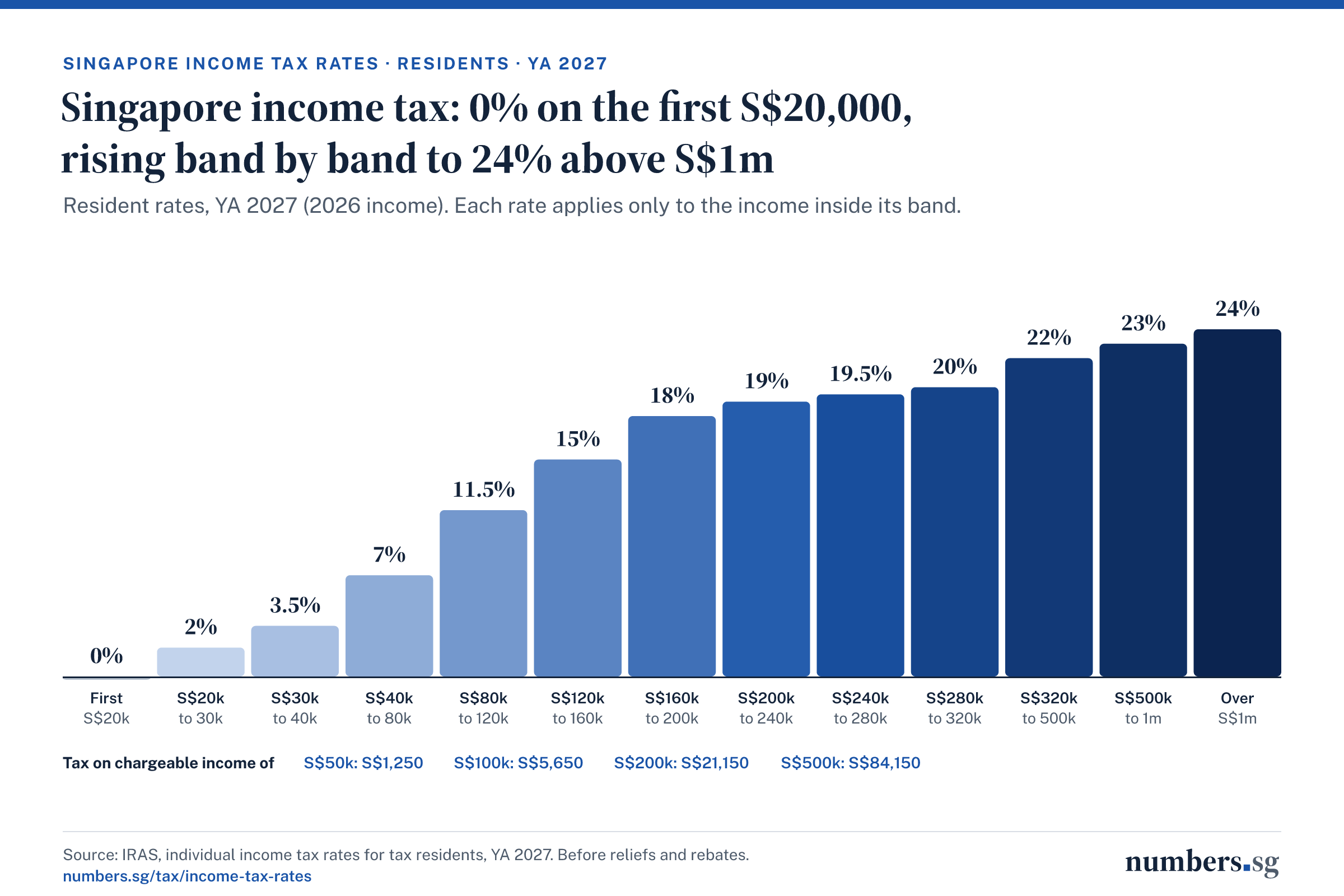
Income tax rates for residents, YA 2026 and YA 2027
Each rate applies only to the part of your chargeable income inside its band. “Tax to here” is the tax on chargeable income at the top of the band, as in IRAS’s own table.
| Chargeable income | Rate | Tax on band | Tax to here |
|---|---|---|---|
| First $20,000 | 0% | $0 | $0 |
| $20,001 to $30,000 | 2% | $200 | $200 |
| $30,001 to $40,000 | 3.5% | $350 | $550 |
| $40,001 to $80,000 | 7% | $2,800 | $3,350 |
| $80,001 to $120,000 | 11.5% | $4,600 | $7,950 |
| $120,001 to $160,000 | 15% | $6,000 | $13,950 |
| $160,001 to $200,000 | 18% | $7,200 | $21,150 |
| $200,001 to $240,000 | 19% | $7,600 | $28,750 |
| $240,001 to $280,000 | 19.5% | $7,800 | $36,550 |
| $280,001 to $320,000 | 20% | $8,000 | $44,550 |
| $320,001 to $500,000 | 22% | $39,600 | $84,150 |
| $500,001 to $1,000,000 | 23% | $115,000 | $199,150 |
| Above $1,000,000 | 24% | on the rest |
IRAS’s rates for tax residents, “from YA 2024 onwards”, read 2 Nov 2026 from IRAS’s rates page. They apply to YA 2026 and YA 2027: Budget 2026 changed none of them.
Tax on your chargeable income
Don’t know your chargeable income? The income tax calculator works it out from your pay and reliefs.
Tax at common salaries
What a citizen aged 35 pays on common salaries for YA 2027, with CPF Relief and Earned Income Relief only. Your own reliefs lower these: put them in the calculator.
| Monthly pay + bonus | Income | Chargeable income | Tax | Of income | Top rate |
|---|---|---|---|---|---|
| $3,000 + 1 month | $39,000 | $30,200 | $207 | 0.5% | 3.5% |
| $4,000 + 1 month | $52,000 | $40,600 | $592 | 1.1% | 7% |
| $5,000 + 1 month | $65,000 | $51,000 | $1,320 | 2% | 7% |
| $6,000 + 2 months | $84,000 | $66,200 | $2,384 | 2.8% | 7% |
| $7,000 + 2 months | $98,000 | $77,400 | $3,168 | 3.2% | 7% |
| $8,000 + 2 months | $112,000 | $90,600 | $4,569 | 4.1% | 11.5% |
| $10,000 + 2 months | $140,000 | $118,600 | $7,789 | 5.6% | 11.5% |
| $12,000 + 3 months | $180,000 | $158,600 | $13,740 | 7.6% | 15% |
| $15,000 + 3 months | $225,000 | $203,600 | $21,834 | 9.7% | 19% |
| $20,000 + 3 months | $300,000 | $278,600 | $36,277 | 12.1% | 19.5% |
| $30,000 + 3 months | $450,000 | $428,600 | $68,442 | 15.2% | 22% |
| $50,000 + 3 months | $750,000 | $728,600 | $136,728 | 18.2% | 23% |
YA 2027 (2026 income), a citizen aged 35 with no reliefs but CPF (CPF Board’s 2026 rates) and the $1,000 Earned Income Relief. More reliefs mean less tax: put in your own.
How the bands work
Chargeable income is your income after donations and personal reliefs. On $50,000 of chargeable income, the first $20,000 is taxed at 0%, the next $10,000 at 2% ($200), the next $10,000 at 3.5% ($350) and the last $10,000 at 7% ($700): $1,250 in all. Moving into a higher band raises the rate only on the dollars above the band’s start, never on the whole income.
Your rate at every income
Two rates matter. Your top rate is the band your last dollar falls in: it is what a raise or an SRS contribution changes. Your average rate is your whole tax divided by your chargeable income, and it is always lower, because every income starts with $20,000 at 0%.
Top rate: tax on your next dollar Average rate: your tax ÷ chargeable income
Tap or hover on the chart to read your tax at any income.
Income tax rates by year, and rebates
A Year of Assessment taxes the income of the year before. So “the tax rate for 2023” can mean two things: income earned in 2023 was taxed in YA 2024, at today’s rates (top rate 24%); YA 2023 taxed income earned in 2022, at the rates IRAS lists for YA 2017 to YA 2023 (top rate 22%). Only the bands above $320,000 differ.
| Chargeable income | YA 2017 to YA 2023 | From YA 2024 |
|---|---|---|
| First $20,000 | 0% | 0% |
| $20,001 to $30,000 | 2% | 2% |
| $30,001 to $40,000 | 3.5% | 3.5% |
| $40,001 to $80,000 | 7% | 7% |
| $80,001 to $120,000 | 11.5% | 11.5% |
| $120,001 to $160,000 | 15% | 15% |
| $160,001 to $200,000 | 18% | 18% |
| $200,001 to $240,000 | 19% | 19% |
| $240,001 to $280,000 | 19.5% | 19.5% |
| $280,001 to $320,000 | 20% | 20% |
| $320,001 to $500,000 | 22% | 22% |
| $500,001 to $1,000,000 | 22% | 23% (rose) |
| Above $1,000,000 | 22% | 24% (rose) |
IRAS’s rates for tax residents, both tables from IRAS’s rates page, read 2 Nov 2026. ▲ marks a band whose rate rose. IRAS’s page lists rates back to YA 2017; today’s apply from YA 2024 to YA 2027.
What the change did at higher incomes:
| Chargeable income | Tax, YA 2017 to 2023 | Tax from YA 2024 | More from YA 2024 |
|---|---|---|---|
| $320,000 | $44,550 | $44,550 | $0 |
| $500,000 | $84,150 | $84,150 | $0 |
| $1,000,000 | $194,150 | $199,150 | $5,000 |
| $2,000,000 | $414,150 | $439,150 | $25,000 |
Rebates. A Personal Income Tax Rebate is a one-off, set in a Budget for one Year of Assessment, and comes off the tax itself. The years IRAS’s pages give:
- YA 2027: none announced so far
- YA 2026: none
- YA 2025: 60% of tax payable, up to $200
- YA 2024: 50% of tax payable, up to $200
- YA 2019: 50% of tax payable, up to $200
- YA 2017: 20% of tax payable, up to $500
The latest years from IRAS’s rebate page and IRAS’s summary of Budget 2026’s tax changes, which includes no rebate; YA 2019 and YA 2017 from IRAS’s worked examples (PDF), which apply them. Read 8 Nov 2026.
Questions people ask
What is the highest income tax rate in Singapore?
24%, on chargeable income above $1 million, since YA 2024. IRAS: “The current highest personal income tax rate is at 24%.”
What were the income tax rates for 2023?
Income earned in 2023 was taxed in YA 2024, at today’s rates: 0% on the first $20,000, rising to 24% above $1 million, with a 50% rebate of up to $200. YA 2023 (2022 income) used the rates for YA 2017 to YA 2023, the same up to $320,000 and then 22% on everything above it. Both tables, band by band.
Is there a 25% rate from YA 2027?
No. Budget 2026’s tax changes include no change to personal income tax rates. Some websites say otherwise; IRAS’s summary of the Budget does not list one.
How much income is tax-free?
The first $20,000 of chargeable income. With reliefs, your income can be higher than that and still pay no tax.
Do foreigners pay the same rates?
Yes, if they are tax residents (usually after 183 days in Singapore in the year). For non-residents, IRAS taxes pay at a flat 15% or the resident rates, whichever is more, and most other income at 24%.
Where the rates come from
- The rates, the tax at the top of each band and the rates before YA 2024 are IRAS’s, from its income tax rates page. The rebates are from IRAS’s rebate page, and Budget 2026 from IRAS’s summary of its tax changes. Read 2 Nov 2026.
- The salary table is worked out by our income tax calculator, which matches IRAS’s worked examples, with CPF from CPF Board’s 2026 rates.
- Not tax advice. No one pays us for this page, and it has no affiliate links. See our disclaimer and corrections.
Changes to this page
Searching “the tax rate for 2023” could mean YA 2023 or income earned in 2023, which IRAS taxes at different rates. The income tax rates page now answers both, band by band, with the rebate for every year IRAS’s pages give, and a chart of your top rate against your average: at $100,000 of chargeable income the next dollar is taxed at 11.5%, the whole at 5.65%.
New: Singapore income tax rates for YA 2026 and YA 2027, band by band with the tax at the top of each, a lookup for your own chargeable income, tax at common salaries, what changed in YA 2024 and the rebates by year. And a Tax section that brings the income tax pages together.