
Investing · from each fund company’s own page
SRS ETFs: every SGX fund you can buy with SRS money, the real fees and the tax when it comes out
Which SGX ETFs you can pay for with SRS money, what each really costs from its own fund company, what iFAST’s new funds add on top, and what you keep after tax.
Money in an SRS account earns 0.05% a year until you invest it. An ETF is one way to do that: a fund listed on SGX that holds a whole index, bought in Singapore dollars through a broker or monthly plan linked to your SRS account. This page lists the ones you can buy, what each really costs, and what you keep after tax.
Lowest fee among these SRS ETFs · checked 28 Nov 2026
0.03% a year
XUS · S&P 500 · in S$ on SGX
MOF keeps no list of approved ETFs. MOF allows ETFs; your SRS bank and broker decide which ones you can pay for with SRS money.
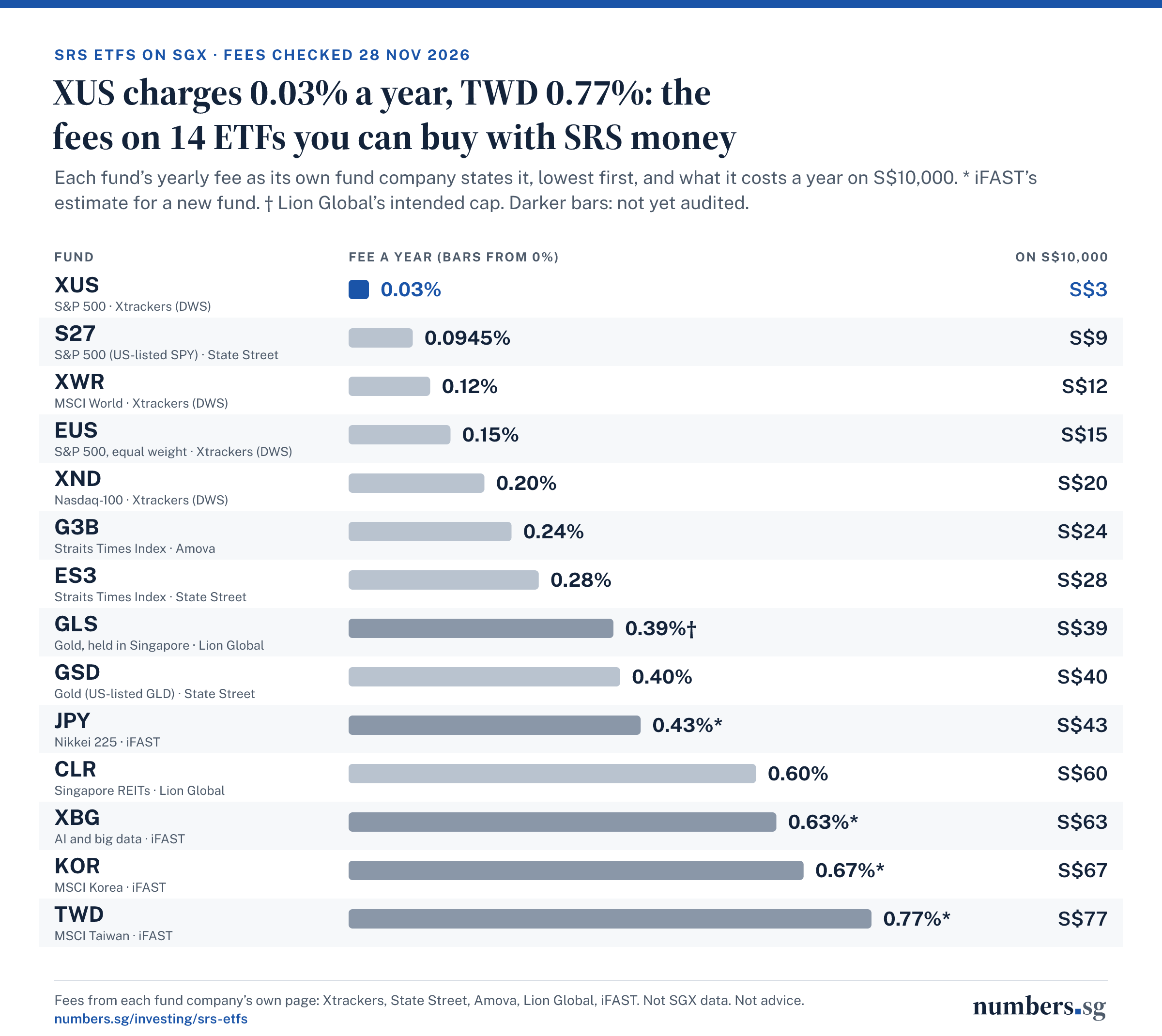
Fee a year, lowest first
- XUSS&P 5000.03%
- S27S&P 500 (US-listed SPY)0.09%
- XWRMSCI World0.12%
- EUSS&P 500, equal weight0.15%
- XNDNasdaq-1000.20%
- G3BStraits Times Index0.24%
- ES3Straits Times Index0.28%
- GLSGold, held in Singapore0.39%†
- GSDGold (US-listed GLD)0.40%
- JPYNikkei 2250.43%*
- CLRSingapore REITs0.60%
- XBGAI and big data0.63%*
- KORMSCI Korea0.67%*
- TWDMSCI Taiwan0.77%*
As each fund company states it, to two decimals. * iFAST’s estimate for a fund launched in October 2026. † The cap Lion Global intends for GLS, listed in March 2026. Bars start at 0%.
SRS money sitting as cash
S$5.0 billion
21% of S$23.88 billion, December 2025
Earning 0.05% a year. 24% is in shares, REITs and ETFs (MOF statistics).
What a Singapore wrapper adds
+0.34%
a year on JPY: 0.43% against 0.09%
JPY is a Singapore fund that holds the Xtrackers Nikkei 225 fund. All four iFAST funds
To get FSM’s S$105
S$50,000
in one ETF by 29 Jan 2027, some in iFAST’s or Amova’s
New to SRS on FSM Global, held to the end, and not through a monthly ETF plan. The terms
In short
You can pay for an SGX-listed ETF with SRS money through a broker or plan linked to your SRS account; MOF names ETFs among what SRS can buy and keeps no list of approved funds. The lowest fee here is Xtrackers’ XUS (S&P 500, 0.03% a year); for the whole developed world, Xtrackers’ XWR charges 0.12%. Both are Irish funds that trade on SGX in Singapore dollars. iFAST’s four new funds (XBG, JPY, KOR, TWD) are Singapore wrappers around Xtrackers funds, so you pay two layers of fees. Inside SRS, gains aren’t taxed until you take the money out; then half of each withdrawal is taxed, and spread over 10 years, about S$400,000 can come out with no tax if you have no other taxable income.
Use this chart
What your SRS money could grow to in an ETF
Pick a fund, put in what you’d invest each month or what’s already sitting in SRS, and how long until you take it out. The calculator takes the fund’s fee off every year, sets the same money beside SRS cash at 0.05%, and works out the tax on the way out with IRAS’s rules. The return is your guess: try a low one and a high one.
The fund’s fee comes off the return every year, as it does inside the fund. Money is paid in at the start of each month. Cash earns 0.05% a year, the rate DBS, OCBC and UOB pay on SRS cash (DBS, OCBC, UOB). Tax uses IRAS’s rates for this year of assessment: half of each withdrawal is taxed (IRAS), spread over 10 years in equal parts. Not counted: broker fees, the gap between buying and selling prices, dividend tax taken inside the fund, and the rates changing. This is arithmetic on your guess of the return, not a forecast.
SGX ETFs you can buy with SRS money
These are the funds in FSM Global’s “SRS-approved ETFs” advert, plus four we added to compare: the other STI fund, the SGX lines of two US funds, and a second gold fund. The two STI funds, ES3 and G3B, have their own page with every payout. Fees are what each fund company states, not a reseller’s summary: when we checked, SGX’s own fund screener showed the wrong fee for XUS and EUS.
| Fund | What it holds | Fee a year | Dividends | Tax taken before it reaches you |
|---|---|---|---|---|
| The world | ||||
| XWR in FSM’s listXtrackers MSCI World UCITS ETFXtrackers (DWS) · Xtrackers XWR page | MSCI World: large and mid-sized companies in developed markets only | 0.12%all-in fee | Kept and reinvested | Irish fund: 15% off its US dividends; other countries take their own rates |
| United States | ||||
| XUS in FSM’s listXtrackers S&P 500 UCITS ETFXtrackers (DWS) · Xtrackers XUS page | S&P 500: about 500 large US companies | 0.03%all-in fee | Kept and reinvested | Irish fund: 15% off its US dividends |
| S27SPDR S&P 500 ETF Trust (SPY), SGX lineState Street · State Street SPY page, POEMS SRS page | S&P 500, as a US-listed fund | 0.0945%expense ratio | Paid out, every quarter | US fund: 30% off each payout; can count for US estate tax |
| EUS in FSM’s listXtrackers S&P 500 Equal Weight UCITS ETFXtrackers (DWS) · Xtrackers EUS page | The same 500 companies, each held at an equal weight | 0.15%all-in fee | Kept and reinvested | Irish fund: 15% off its US dividends |
| XND in FSM’s listXtrackers NASDAQ 100 UCITS ETFXtrackers (DWS) · Xtrackers XND page | Nasdaq-100: the 100 largest non-financial companies on Nasdaq | 0.20%all-in fee | Kept and reinvested | Irish fund: 15% off its US dividends |
| Japan, Korea, Taiwan | ||||
| JPY in FSM’s listiFAST Xtrackers Nikkei 225 UCITS Index ETFiFAST · iFAST JPY page, Beansprout, from iFAST | Nikkei 225: 225 large Japanese companies | 0.43%iFAST’s estimate | Kept and reinvested (no payouts) | Through a Luxembourg fund: each company’s home country takes its own rate |
| KOR in FSM’s listiFAST Xtrackers MSCI Korea UCITS Index ETFiFAST · FSM research | MSCI Korea 20/35: Korean companies, one group capped at 35% | 0.67%iFAST’s estimate | Not stated by iFAST yet | Through a Luxembourg fund: each company’s home country takes its own rate |
| TWD in FSM’s listiFAST Xtrackers MSCI Taiwan UCITS Index ETFiFAST · FSM research | MSCI Taiwan 20/35: Taiwanese companies, one group capped at 35% | 0.77%iFAST’s estimate | Not stated by iFAST yet | Through a Luxembourg fund: each company’s home country takes its own rate |
| A theme | ||||
| XBG in FSM’s listiFAST Xtrackers Artificial Intelligence & Big Data UCITS Index ETFiFAST · Beansprout, from iFAST | Nasdaq Global AI and Big Data index: companies worldwide in AI and data | 0.63%iFAST’s estimate | Not stated by iFAST yet | Through an Irish fund: 15% off US dividends; other countries their own rates |
| Singapore | ||||
| G3B in FSM’s listAmova Singapore STI ETFAmova · Amova G3B page, G3B annual report | Straits Times Index: Singapore’s 30 largest companies | 0.24%audited, year to 30 June 2025, the latest audited | Paid out, twice a year | None on Singapore companies’ dividends |
| ES3SPDR Straits Times Index ETFState Street · State Street ES3 page, ES3 annual report | Straits Times Index: Singapore’s 30 largest companies | 0.28%audited, year to 30 June 2026 | Paid out, twice a year | None on Singapore companies’ dividends |
| CLR in FSM’s listLion-Phillip S-REIT ETFLion Global · Lion Global CLR page | Morningstar Singapore REIT Yield Focus Index: Singapore REITs | 0.60%audited, year to 31 December 2025 | Paid out, twice a year | No foreign tax on Singapore REIT payouts |
| Gold | ||||
| GLS in FSM’s listLionGlobal Singapore Physical Gold ETFLion Global · Lion Global gold page | Gold bars held in Singapore | 0.39%Lion’s intended cap | None: gold pays no dividends | None: gold pays no dividends |
| GSDSPDR Gold Shares (GLD), SGX lineState Street · SPDR Gold Shares page, POEMS SRS page | Gold bars held by the trust’s custodians | 0.40%expense ratio | None: gold pays no dividends | No dividends; as a US fund it can count for US estate tax |
Fees as each issuer’s own page stated them on 28 Nov 2026: Xtrackers’ “all-in fee”, State Street’s, Amova’s and Lion Global’s expense ratios from their annual reports or fund pages, iFAST’s estimates for funds too new to have a report. GLS listed in March 2026 and has no expense ratio yet; Lion Global says it intends to cap it at 0.39% a year and pay anything above that itself. Whether your broker lets you pay for a fund with SRS is its call: check the order screen or ask. No fund manager, broker or exchange pays us.
“Kept and reinvested” means the fund doesn’t pay dividends; they go back into the fund and show up in its price. For SRS money that is no loss: payouts from the paying funds land in your SRS account as cash, earning 0.05% until you invest them again.
“SRS-approved” isn’t an official list
MOF’s SRS page says SRS money can buy shares, unit trusts, bonds, fixed deposits, some life insurance and ETFs, and rules out direct property. It doesn’t name funds. What you can actually buy depends on two firms:
- Your SRS bank (DBS/POSB, OCBC or UOB) holds the money and the investments, and pays when you buy.
- Your broker or plan decides which counters it lets you pay for with SRS. POEMS, for example, takes SRS for SGX-listed shares, ETFs and bonds, and shows “SRS” as a payment type on the order screen when a counter can take it (POEMS).
So when a platform says “SRS-approved ETFs”, it means the ETFs it lets you buy with SRS. FSM Global says over 100 ETFs on its platform qualify. The quickest check is the order screen: if SRS is offered as a way to pay, the counter qualifies there.
iFAST’s four new funds: two layers of fees
XBG, JPY, KOR and TWD started trading on SGX on 22 October 2026. Each is a Singapore fund that puts almost all its money into one Xtrackers fund listed in Europe, which in turn holds the shares. You pay the Xtrackers fund’s fee inside it, and iFAST’s own fees on top.
| iFAST fund | Holds | That fund’s fee | iFAST’s estimated total | Added in Singapore |
|---|---|---|---|---|
| JPY iFAST Xtrackers Nikkei 225 UCITS Index ETF | Xtrackers Nikkei 225 UCITS ETF, Luxembourg | 0.09% Xtrackers Nikkei 225 page | 0.43% | +0.34% |
| KOR iFAST Xtrackers MSCI Korea UCITS Index ETF | an Xtrackers MSCI Korea UCITS fund, Luxembourg | Not stated | 0.67% | At least 0.25%: iFAST’s management fee |
| TWD iFAST Xtrackers MSCI Taiwan UCITS Index ETF | an Xtrackers MSCI Taiwan UCITS fund, Luxembourg | Not stated | 0.77% | At least 0.25%: iFAST’s management fee |
| XBG iFAST Xtrackers Artificial Intelligence & Big Data UCITS Index ETF | Xtrackers Artificial Intelligence & Big Data UCITS ETF, Irish | 0.35% Xtrackers AI & Big Data page | 0.63% | +0.28% |
iFAST’s totals are its estimates for funds launched on 22 October 2026: KOR and TWD from FSM Global’s research note, XBG and JPY from iFAST’s figures as at 31 August 2026 as Beansprout reported them. iFAST’s management fee is 0.25% a year (up to 0.90%), and other charges “may each amount to or exceed 0.10% per annum” (iFAST’s JPY page). The Xtrackers funds’ fees are from Xtrackers’ own pages; for KOR and TWD, iFAST doesn’t name the share class it holds, so we leave that fee blank rather than guess.
What the wrapper gives you: Japanese, Korean and Taiwanese shares in Singapore dollars, during Singapore hours, in lots of one unit, payable with SRS. FSM Global calls KOR and TWD the first SGX ETFs for Korea and for Taiwan. What it costs: on S$10,000 in JPY, about S$34 a year more than the Xtrackers fund it holds would cost on its own. That fund isn’t sold on SGX, so for SRS money the choice is the wrapper or nothing.
iFAST’s four are the ones in the advert, but any fund can be built this way. To tell, read the fund’s factsheet or prospectus: a feeder says it invests all or nearly all its money in another named fund, and its own fee comes on top of that fund’s.
One more thing the advert doesn’t say: iFAST Financial is both the manager of these funds and the company that runs FSM Global, and it keeps the management fee itself. FSM’s own research on KOR and TWD is open about the trade-off: it still prefers two cheaper US-listed Korea and Taiwan funds for investors who can use them, which SRS money can’t.
The S&P 500 with SRS money: XUS, SPY or CSPX
SGX has two S&P 500 funds you can pay for with SRS money. S27 is the SGX line of the US-listed SPY and trades in US dollars; its payouts lose 30% to US tax before they reach a Singapore holder, and it can count as US property for US estate tax. XUS holds the same index from Ireland, has traded in Singapore dollars since 13 October 2026 (SGX’s announcement), and loses about half as much of its dividends to tax.
| Fund | Fee | Dividend tax | A year in all | With SRS money | US estate tax |
|---|---|---|---|---|---|
| XUS Irish, in S$ on SGX | S$3 | S$17 | S$20 | Yes, through brokers and plans that offer it | No: shares of an Irish company |
| S27 (SPY’s SGX line) US, in US$ on SGX | S$9 | S$36 | S$45 | POEMS names it among its SRS ETFs | Yes, above US$60,000 of US property |
| CSPX Irish, in US$ in London | S$7 | S$17 | S$24 | Not with the SRS routes on this page: they buy on SGX | No |
On S$10,000. Dividend tax is the S&P 500’s dividend yield (1.186%, what CSPX’s fund received in its year to 31 July 2026) times the share lost to tax: 14.1% for an Irish fund, measured in CSPX’s audited report, which we use for XUS too because it holds the same index from the same country; 30% for a US fund paying a Singapore resident (IRS Pub 515). Holding it in SRS doesn’t change this: the tax is taken before anything reaches your SRS account. Full workings on our VWRA and CSPX page.
CSPX, which many Singapore investors hold in an ordinary brokerage account, trades in London, and the SRS routes on this page buy on SGX. Inside SRS, XUS does the same job for a little less a year.
Where to buy them with SRS money
First you need an SRS account with DBS/POSB, OCBC or UOB; our SRS page sets the three side by side. Then there are two ways in: a monthly plan, which buys a fixed amount each month, often in fractions of a unit, or a broker, where you place each order yourself. Either way, you link your SRS account to it, and the plan or broker asks your SRS bank for the money.
| Where | How it charges | Paying with SRS | Which ETFs |
|---|---|---|---|
| FSM Global FSM RSP page, FSM promotion terms, FSM pricing | Monthly plan from S$50 per ETF; FSM has waived the buy fee on ETF plans since 2021, “until further notice”. | Pay with SRS from any of the three SRS banks. | Over 100 ETFs on FSM can be bought with SRS money, FSM says, across SGX and other markets. |
| OCBC Blue Chip Investment Plan OCBC BCIP page | Monthly plan from S$100 per counter: 0.88% of each buy up to S$500 a counter a month; above that, 0.3% or S$5 a counter, whichever is more. | OCBC SRS accounts only, with an extra S$0.35 CDP fee plus GST per counter. | Seven ETFs: G3B, CLR, Lion-OCBC China Leaders, Lion-OCBC Hang Seng Tech, Lion-OCBC Singapore Low Carbon, Amova-ICBCSG China Bond and Amova SGD Investment Grade Corporate Bond. |
| POEMS (Phillip Securities) POEMS SRS page | Buys at its normal brokerage when you place an order. | SGX-listed shares, ETFs and bonds with SRS money; SRS shows as a payment type on the order screen when a counter can take it. | Its SRS page names ES3, Lion-OCBC Hang Seng Tech, SPDR S&P 500, Lion-Phillip S-REIT and SPDR Gold. |
| DBS Vickers DBS | Buys at its normal brokerage when you place an order. | Link your DBS/POSB SRS account to a DBS Vickers online trading account. | Ask DBS Vickers which counters take SRS. |
From each one’s own page, read 28 Nov 2026. Brokerage for one-off orders differs by broker and changes; check the broker’s price list before you buy. We have no referral link to any of them on this page.
FSM Global’s SRS cashback: what it really takes
FSM’s advert pairs “up to S$105 cashback” with monthly plans “from S$50”. The terms don’t let the two meet: a monthly ETF plan doesn’t count, and S$105 needs at least S$50,000 in one ETF, S$10,000 or more of the money in iFAST’s or Amova’s ETFs, and no earlier use of SRS money on FSM.
| Net amount in one ETF | New to SRS on FSM | Already used SRS on FSM | Credit as a share |
|---|---|---|---|
| S$10,000 to S$19,999 | S$20 | S$10 | 0.20% at most |
| S$20,000 to S$49,999 | S$40 | S$20 | 0.20% at most |
| S$50,000 or more | S$100 | S$50 | 0.20% at most |
- At least S$10,000 net in one ETF during the promotion: amounts can’t be split across ETFs to reach it.
- ETFs bought through FSM’s SRS regular savings plan don’t count. Unit trusts bought through it do.
- Net of anything you sell, and you must hold until the end of the promotion.
- “New” means you have never moved SRS money in or bought anything with SRS money on FSM Global.
- The extra S$5 needs at least S$10,000 in iFAST’s or Amova’s ETFs. iFAST runs FSM Global and manages XBG, JPY, KOR and TWD.
From FSM promotion terms, read 28 Nov 2026: 2 Nov 2026 to 29 Jan 2027, credits paid 6 to 8 weeks after the promotion ends, as FSM Global cash account credits. Plus S$5 when at least S$10,000 goes into iFAST’s or Amova’s ETFs, so S$105 at most for someone new and S$55 for someone who has used SRS on FSM before. FSM can change or end the promotion.
A citizen or PR can pay at most S$15,300 into SRS a year, so the top tier is for money already in the account. At its best, with the extra S$5, the credit is 0.21% of what you put in, once: less than one year of the 0.34% that iFAST’s layer adds to JPY.
Tax, from paying in to taking out
Paying in cuts your tax this year
Each dollar you put into SRS comes off your taxable income, up to S$15,300 a year for citizens and PRs and S$35,700 for foreigners. What that saves at your pay is on our SRS page.
No tax while it’s invested
Gains and dividends inside SRS aren’t taxed until you take the money out.
SourceMOF
Tax taken inside a fund stays taken
The US’s 15% (Irish funds) or 30% (US funds) comes off dividends before anything reaches your SRS account; SRS can’t get it back.
SourceIRS Publication 515
Half of each withdrawal is taxed
From your withdrawal age, which is fixed by the year of your first contribution, half of what you take out is added to your income for that year, and taxed at your rate; our income tax calculator shows what that comes to.
SourceIRAS
Spread it over 10 years
IRAS’s own example: S$400,000 taken out as S$40,000 a year, with no other income, pays no tax, because the taxed half, S$20,000, sits in the 0% band.
SourceIRAS
You can take out the ETF itself
Since 1 July 2015, withdrawals can be in the form of investments, so you needn’t sell to withdraw.
SourceMOF
What’s left after 10 years counts as withdrawn
At the end of the 10-year window, the cash and the market value of investments still in the account are treated as taken out, and taxed that way.
SourceIRAS
Taking it out early costs more
Before your withdrawal age, all of a withdrawal is taxed and there is a 5% penalty.
SourceIRAS
Investing 18 pages
- SRS accountDBS, OCBC and UOB compared, tax saved for YA 2027 and the withdrawal rules
- STI ETFs side by sideES3 and G3B fees, payouts and how closely they track
- VWRA and CSPX investorsFees, the 15% US tax, estate tax, accumulating or distributing
- Dividend calendarUpcoming ex-dates and payouts for SGX shares, REITs and ETFs
- DBS dividendEvery payout, ex-date and pay date, and the history as actually paid
- OCBC dividendEvery payout, ex-date and pay date, the capital return and scrip
- SIA dividendEvery payout, ex-date and pay date, and the special package
- UOB dividendEvery payout, ex-date and pay date, the S$3 billion package and scrip
- New · 17 NovSembcorp dividendEvery payout since 1998, its dates, and the Sembcorp Marine shares handed out in 2020
Also: Singtel dividend · CDP account · Scrip dividends and reinvestment plans on SGX · CICT dividend · Keppel dividend · ST Engineering dividend · Venture dividend · Genting Singapore dividend
Questions
Can I buy ETFs with SRS money?
Yes. MOF lists ETFs among what SRS can buy. You need an SRS account with DBS/POSB, OCBC or UOB, linked to a broker or plan that takes SRS for the ETF you want. The money never leaves the SRS account: the bank pays and holds the units.
Which ETFs are SRS-approved?
There is no official list. MOF allows ETFs in general; each broker or plan decides which counters it lets you pay for with SRS. The table above covers the funds in FSM’s advert and four more, and POEMS shows “SRS” as a payment type on any counter that qualifies there.
Can I buy the S&P 500 with SRS?
Yes, through an SGX-listed fund. XUS (Irish, in Singapore dollars, 0.03% a year) is the cheaper; S27 is the SGX line of the US-listed SPY. XUS loses less of its dividends to US tax and isn’t US property for estate tax. The comparison.
Can I buy CSPX or VWRA with SRS?
Not through the routes on this page, which buy on SGX; CSPX and VWRA trade in London. XUS and XWR are the closest SGX funds. Ask your broker if it offers anything wider.
Do I pay tax on ETF dividends inside SRS?
Not while they stay in SRS. Any tax a foreign country takes inside the fund is still lost, and half of everything you later withdraw, dividends and gains included, is taxed as income in the year it comes out.
Do I have to sell my ETFs to withdraw?
No. Since July 2015 you can withdraw investments as they are. They’re valued at the time, and half of that value is taxed, as with cash.
What is the minimum to start?
On FSM Global’s monthly ETF plan, S$50 a month; on OCBC’s Blue Chip Investment Plan, S$100 a month a counter. With a broker, the smallest order is one board lot; iFAST’s four funds trade in lots of one unit.
Is the FSM cashback worth chasing?
Only if you were putting S$10,000 or more into a single ETF with SRS money anyway. Monthly ETF plans don’t count, and the S$105 top figure needs S$50,000 or more in one ETF, some of it in iFAST’s or Amova’s funds, and no earlier SRS use on FSM. The tiers.
Changes to this page
Nothing on the SRS ETFs page has needed correcting since it went up on 28 November 2026; a correction would be listed here, dated.
- New
SGX ETFs you can buy with SRS money, each fee read from the fund company’s own page.
MoreLess
XUS charges 0.03% a year for the S&P 500; iFAST’s four new funds (XBG, JPY, KOR, TWD) are Singapore wrappers around Xtrackers funds, so JPY costs about 0.43% a year against 0.09% for the fund it holds. FSM Global’s “up to S$105” SRS cashback needs S$50,000 in one ETF and doesn’t count monthly ETF plans. A calculator sets your SRS money in a fund against SRS cash at 0.05%, after the fee and the tax when it comes out.
How we know this
Each fund’s fee, dividend policy and structure come from its own company’s page: Xtrackers for XUS, XWR, XND, EUS and the two funds iFAST’s XBG and JPY hold; iFAST’s own product page and FSM Global’s research for the iFAST funds; State Street for ES3, SPY and SPDR Gold Shares; Amova for G3B; Lion Global for CLR and GLS. We never take fund data from SGX’s website or its screener: SGX’s terms don’t allow it to be republished. The promotion terms, plan fees and SRS options come from FSM Global’s, OCBC’s, POEMS’s and DBS’s own pages; the rules from MOF, IRAS and the IRS. All read on 28 Nov 2026. We re-read the fees every three months, FSM’s promotion before it ends, and the iFAST funds when their first annual report comes out.
This page explains costs and rules; it isn’t advice on what to buy, and past returns don’t tell you future ones.
How we earn: no fund company, broker or exchange pays us for this page, and it has no referral links. Elsewhere on Numbers.sg we have referral codes or links for moomoo, Tiger Brokers and Interactive Brokers; none is named here.