
Currency · MAS and the ECB
SGD to CNY today, and CNY to SGD
What S$1 buys in Chinese yuan, what your amount comes to by card, app, bank or money changer, CNY and CNH at DBS, and the rate since 1993.
S$1 in Chinese yuan
RMB 5.1680
- S$100
- RMB 516.80
- S$1,000
- RMB 5,168
The mid-market rate: MAS’s rate at noon, 20 Nov. From MAS’s own exchange rate figures.
RMB 1,000 in Singapore dollars
S$193.50
- RMB 100
- S$19.35
- RMB 10,000 (1万)
- S$1,935.00
The same rate the other way: RMB 1 is S$0.1935.
Against the past 10 years
61% of days, fewer yuan
S$1 bought fewer yuan than today on 61% of working days in the past ten years, and on 0% in the past year: about average for the past ten years, weak for this year. Past year: RMB 5.1653 (19 Nov 2026) to RMB 5.5066 (28 Jan 2026).
Few people get the mid-market rate: most banks, cards, apps and money changers give you a little less yuan on each dollar, or fewer dollars for your yuan, and keep the difference. On S$1,000 changed today the gap runs from about RMB 29 with Instarem to RMB 236 with OFX. Every way, side by side
Your amount, every way to change
Put in how much you are changing, either way. Yuan can be typed as 3万, 3万元 or 30k. At a money changer, add the rate on its board to see what it costs you against the mid-market rate, Wise and DBS.
S$1,000 in Chinese yuan today, each way
| Way | You get | Less than mid-market | How |
|---|---|---|---|
| Mid-market rateNobody: the yardstick | RMB 5,168 | – | Not a price you can get |
| Card with no FX fee, in ChinaPaying by card in China | About RMB 5,168 | No fee, at its own rate | Card or app; YouTrip needs a top-up first |
| Revolut (Standard plan), weekdayPaying by card, or an exchange in the app | About RMB 5,168 | No fee, at its own rate | App; the limit is per calendar month |
| InstaremSent to an account in China | RMB 5,139 | RMB 29 | Fee S$6.50, as Wise collected it at 4:39 pm, 22 Nov |
| WiseYuan sent to an account in China, or held in Wise | RMB 5,113 | RMB 55 | An app |
| HSBC SingaporeSent to an account in China | RMB 5,105 | RMB 63 | Fee S$0.00, as Wise collected it at 3:40 pm, 20 Nov |
| DBS’s CNH rateOffshore yuan (CNH) from DBS | RMB 5,093 | RMB 75 | DBS or POSB account |
| DBS’s CNY rateOnshore yuan (CNY) from DBS | RMB 5,084 | RMB 84 | DBS or POSB account |
| Singapore bank card, in ChinaPaying by card in China | About RMB 5,005 | RMB 163 | Any Singapore Visa or Mastercard |
| OFXSent to an account in China | RMB 4,932 | RMB 236 | Fee S$15.00, as Wise collected it at 4:34 pm, 22 Nov |
Wise’s and DBS’s rates and fees read today; the other providers as Wise’s public price comparison collected them for sending S$1,000 to an account in China, at the times shown (a price collected earlier may have changed since; Wise is one of the providers compared). “About” rows apply the published fee to the mid-market rate, because the provider’s own rate isn’t published in a form we read. Wise’s rate is today’s and the mid-market rate is MAS’s rate at noon, 20 Nov, so a provider can come out a little above it when the yuan has moved since. A money changer sets its own rate: type it into the converter to see where it falls. No one pays us to list any of these, and there are no affiliate links.
Every common amount
S$ to yuan at the amounts people take on a trip or send, each way, worked out the same way as the converter.
Yuan you get for each amount
| S$ | Mid-market | Wise | DBS CNY | DBS CNH | Bank card (about) |
|---|---|---|---|---|---|
| 517 | 493 | 508 | 509 | 501 | |
| 1,034 | 1,006 | 1,017 | 1,019 | 1,001 | |
| 2,584 | 2,546 | 2,542 | 2,546 | 2,503 | |
| 5,168 | 5,113 | 5,084 | 5,093 | 5,005 | |
| 10,336 | 10,245 | 10,168 | 10,185 | 10,011 | |
| 15,504 | 15,378 | 15,253 | 15,278 | 15,016 | |
| 25,840 | 25,644 | 25,421 | 25,463 | 25,026 | |
| 51,680 | 51,308 | 50,842 | 50,925 | 50,053 |
In yuan, rounded to the yuan. Tap an amount to load it into the converter. Wise’s fee is a fixed part plus a share, so it costs a little more on small amounts; DBS’s posted rates and a bank card’s 3.25% are the same share at every amount.
Chinese prices in S$
What a price in China costs you in Singapore dollars today, at the mid-market rate and on a Singapore bank card.
| Price in yuan | S$ at mid-market | On a bank card (about) |
|---|---|---|
| S$1.94 | S$2.00 | |
| S$9.68 | S$9.99 | |
| S$19.35 | S$19.98 | |
| S$38.70 | S$39.96 | |
| S$96.75 | S$99.89 | |
| S$193.50 | S$199.79 | |
| S$387.00 | S$399.58 | |
| S$967.50 | S$998.94 | |
| S$1,935.00 | S$1,997.89 | |
| S$9,675.00 | S$9,989.44 | |
| S$19,350.00 | S$19,978.88 | |
| S$193,500.00 | S$199,788.75 |
At RMB 5.1680 for S$1 (MAS’s rate at noon, 20 Nov). “On a bank card” adds DBS and POSB’s fee of up to 3.25% to the mid-market rate; Visa’s and Mastercard’s own rates differ a little from it. 万 is ten thousand: a price of 1.2万 is RMB 12,000. In China a price written ¥ or 元 is in yuan. Tap a price to load it into the converter.
China’s limits, in S$ today
These are set in yuan or US dollars by China’s government, so what they come to in S$ moves with the rate.
| What | Set at | S$ today |
|---|---|---|
| Departure tax refund: the least you can spendIn one store on one day. Tax refund | RMB 200 | S$38.70 |
| Departure tax refund: most paid in cashState Council | RMB 20,000 | S$3,870 |
| Cash you declare entering ChinaOr above. Customs guide | RMB 20,000 or US$5,000 | S$3,870 / S$6,454 |
| Alipay or Weixin on a foreign card: one paymentThe most. State Council | US$5,000 | S$6,454 |
| Alipay or Weixin on a foreign card: a yearThe most. State Council | US$50,000 | S$64,540 |
| SAFE’s yearly quota per personWho it applies to | US$50,000 | S$64,540 |
Each from the government page linked, read 2 Nov 2026 and re-checked on our update schedule. Yuan in S$ at the mid-market rate; US$ in S$ at MAS’s noon rate for 20 Nov (S$1.2908 for US$1, from our USD to SGD page).
Going to China: visa, paying, tax refund and cash
- No visa for up to 30 days. Singapore’s Immigration & Checkpoints Authority: “Similarly, holders of ordinary passports issued by Singapore will be exempted from visa requirements for a stay of up to 30 days in the PRC.” The arrangement started on 9 February 2024 (ICA, read 2 Nov 2026). Check the rules for your own trip before you go.
- Paying with Alipay or Weixin (WeChat) Pay. China’s State Council: “In Alipay and WeChat Pay, foreign users can link their international credit cards, including Visa and Mastercard, to these platforms.” “The single transaction limit for overseas visitors using mobile payments on payment platforms has now been raised from 1,000 U.S. dollars to 5,000 dollars.” “The annual cumulative transaction cap has been increased from 10,000 dollars to 50,000 dollars.” (Payment service guide for overseas visitors to China, 11 April 2024). Your card is charged in yuan and your bank or card converts it, as in the table at the top. Alipay and Weixin may add their own fee on a foreign card: check in the app before you pay. We found no page of Alipay’s or Weixin’s own that states it, so we don’t quote a figure.
- Pay in yuan, not S$. A shop, hotel or ATM may offer to charge your Singapore card in S$. That is Dynamic Currency Conversion: “The exchange rate is set by the merchant or its DCC provider”, in DBS and POSB’s words, and DBS and POSB still add 1% on a credit card and 2.8% on a debit card (DBS and POSB).
- Tax refund when you shop. “The minimum purchase threshold for departure tax refunds has been lowered, allowing overseas travelers to apply for a refund if they spend at least 200 yuan (about 27.75 U.S. dollars) at the same store on the same day and meet other relevant requirements.” “Earlier this month, China announced a nationwide shift from a refund-upon-departure model to a refund-upon-purchase model for departure tax refunds, enabling foreign visitors to instantly claim value-added tax rebates at tax-free stores across the country.” “The upper limit for cash refunds has been raised to 20,000 yuan.” (China refines departure tax refund policy to encourage inbound consumption, 27 April 2025). RMB 200 is about S$38.70 at today’s rate.
- Carrying cash. Entering China, the customs guide lists “RMB20,000 cash or above, or any other foreign currencies in cash equivalent to $5,000USD or above.” among the things to declare (Shanghai Municipal People’s Government (from the General Administration of Customs)). RMB 20,000 is about S$3,870. Leaving Singapore: “If you move physical currency and bearer negotiable instruments (or CBNI) exceeding SGD 20,000 (the prescribed amount) or its equivalent in a foreign currency into or out of Singapore, you are required to make a Cash Movement Report.” (Singapore Police Force).
Each quoted word for word from the page linked, read 2 Nov 2026, and re-checked on our update schedule. The State Council’s pages are its English news site (english.www.gov.cn). This page doesn’t give visa, customs or tax advice.
CNY and CNH: two rates for one yuan
The yuan is traded in two markets: in mainland China (CNY) and outside it (CNH). The Hong Kong Monetary Authority calls the second the “offshore renminbi (RMB) market in Hong Kong (i.e. CNH market)” (HKMA). It is the same currency, but the two rates can differ a little, and DBS posts both.
| Rate | Yuan for S$1 | On S$1,000 | Against mid-market |
|---|---|---|---|
| Mid-marketMAS’s rate at noon, 20 Nov | 5.1680 | RMB 5,168 | – |
| DBS sells you onshore yuan (CNY)Posted transfer rate, 6:03 am, 22 Nov | 5.0842 | RMB 5,084 | −1.62% |
| DBS sells you offshore yuan (CNH)Posted transfer rate, 6:03 am, 22 Nov | 5.0925 | RMB 5,093 | −1.46% |
Today DBS’s CNY rate gives RMB 8 less on S$1,000 than its CNH rate. DBS posts a buying rate for CNH only: to sell yuan to DBS, it is the CNH rate (RMB 5.2610 for S$1).
DBS’s rates from the data behind DBS’s foreign exchange rates page, with DBS’s own time on it (S$ for RMB 1, which we turn into yuan for S$1). China’s own daily reference rate for the S$ (the central parity, SGD/CNY) is published by China Foreign Exchange Trade System (CFETS); we link to it rather than show it, because CFETS’s terms need written permission to republish its data.
Is today’s SGD to CNY rate good?
It depends which way you are changing: a rate that is good for a trip to China is bad for changing yuan into S$. Here is today’s rate against every working day of the past year, five years and ten years.
Changing S$ into yuan (a trip to China, or money sent there): at RMB 5.1680 for S$1 (MAS’s rate at noon, 20 Nov), your Singapore dollars buy more yuan than on 0% of days in the past year, 26% of days in the past five years and 61% in the past ten.
Changing yuan into S$: it runs the other way. Your yuan buy fewer S$ today than on 0% of days in the past year and 26% in the past five.
| Over | Average | Fewest | Most | Days S$1 bought fewer |
|---|---|---|---|---|
| The past year | 5.3302 | 5.165319 Nov 2026 | 5.506628 Jan 2026 | 0% |
| The past 5 years | 5.2577 | 4.62759 Mar 2022 | 5.63062 Jul 2025 | 26% |
| The past 10 years | 5.0972 | 4.62759 Mar 2022 | 5.63062 Jul 2025 | 61% |
| Since 2003 | 4.9823 | 4.40332 Mar 2009 | 5.63062 Jul 2025 | 81% |
We don’t forecast exchange rates, and no one can say where this one goes next. What the past shows: over the past year S$1 bought between RMB 5.1653 and RMB 5.5066, a gap of RMB 341 on S$1,000. Changing part now and part later evens out the highs and lows; the rate alert can tell you when S$1 buys the most yuan in a year. Yuan for S$1 each working day, MAS’s noon rates.
CNY to SGD: Chinese yuan to Singapore dollars
For yuan pay or savings, money from family in China, or yuan left over from a trip. The converter above works this way too: choose “RMB to S$”.
Sending RMB 10,000 to Singapore
What arrives in a Singapore account, as Wise’s comparison shows it. Wise lists only its own quote for yuan to S$.
| Provider | S$ arriving | Fee | Rate, S$ for RMB 1 | Quoted |
|---|---|---|---|---|
| WiseWise’s own quote | S$1,917.45 | RMB 83.39 | 0.1934 | 6:16 pm, 22 Nov |
From Wise’s public price comparison, at the time shown.
Yuan notes and leftover yuan
- Selling yuan back. A money changer or bank buys yuan at its own buying rate, which gives you fewer S$ than the mid-market rate. DBS’s posted rate for buying offshore yuan (CNH) today is RMB 5.2610 for S$1, against RMB 5.1680 mid-market: RMB 1,000 comes to S$190.08 instead of S$193.50. Put a changer’s “we buy” rate into the converter (choose “RMB to S$”) to compare.
- Keeping it for the next trip. Yuan kept as notes earns nothing, and its worth in S$ moves with the rate: the chart shows how far that has gone, both ways.
China’s US$50,000 a year quota
Large sums from China go through banks there, under the State Administration of Foreign Exchange’s rules. SAFE, when the quota was set: “Management of an annual quota shall be applicable to individual foreign exchange sales and domestic individual foreign exchange purchases, and it is specified in the Detailed Rules that the respective annual quota shall be USD 50,000.” It also spoke of “the application of management of an annual quota on sales of foreign exchange for both domestic and foreign individuals” and said: “Within the total annual quota, individuals can directly handle the formalities in the banks with their valid identity documents.” (SAFE, 5 January 2007).
US$50,000 is about S$64,540 today, or about RMB 333,540 (33.35万) at the mid-market rate (US$ in S$ at MAS’s noon rate for 20 Nov; S$ in yuan at MAS’s rate at noon, 20 Nov).
SAFE’s words are from 2007, when the US$50,000 quota was set; which transactions it covers depends on who you are and what the money is for, so ask your bank in China. This page doesn’t give advice on moving money out of China.
S$ to RMB and back: quick tables
| S$ | Yuan |
|---|---|
| S$1 | RMB 5.17 |
| S$5 | RMB 25.84 |
| S$10 | RMB 51.68 |
| S$20 | RMB 103.36 |
| S$50 | RMB 258.40 |
| S$100 | RMB 516.80 |
| S$200 | RMB 1,033.59 |
| S$500 | RMB 2,583.98 |
| S$1,000 | RMB 5,168 |
| S$2,000 | RMB 10,336 (1.03万) |
| S$5,000 | RMB 25,840 (2.58万) |
| S$10,000 | RMB 51,680 (5.17万) |
| S$100,000 | RMB 516,796 (51.68万) |
| Yuan | S$ |
|---|---|
| RMB 1 | S$0.1935 |
| RMB 10 | S$1.94 |
| RMB 50 | S$9.68 |
| RMB 100 | S$19.35 |
| RMB 500 | S$96.75 |
| RMB 1,000 | S$193.50 |
| RMB 5,000 | S$967.50 |
| RMB 10,000 (1万) | S$1,935.00 |
| RMB 50,000 (5万) | S$9,675.00 |
| RMB 100,000 (10万) | S$19,350.00 |
| RMB 1,000,000 (100万) | S$193,500.00 |
| RMB 10,000,000 (1,000万) | S$1,935,000.00 |
At the mid-market rate of RMB 5.1680 for S$1 (MAS’s rate at noon, 20 Nov). What you get from a bank, card or money changer is a little less: Every common amount shows what each way to change gives, and the converter works it out for yours.
SGD to CNY since 1993
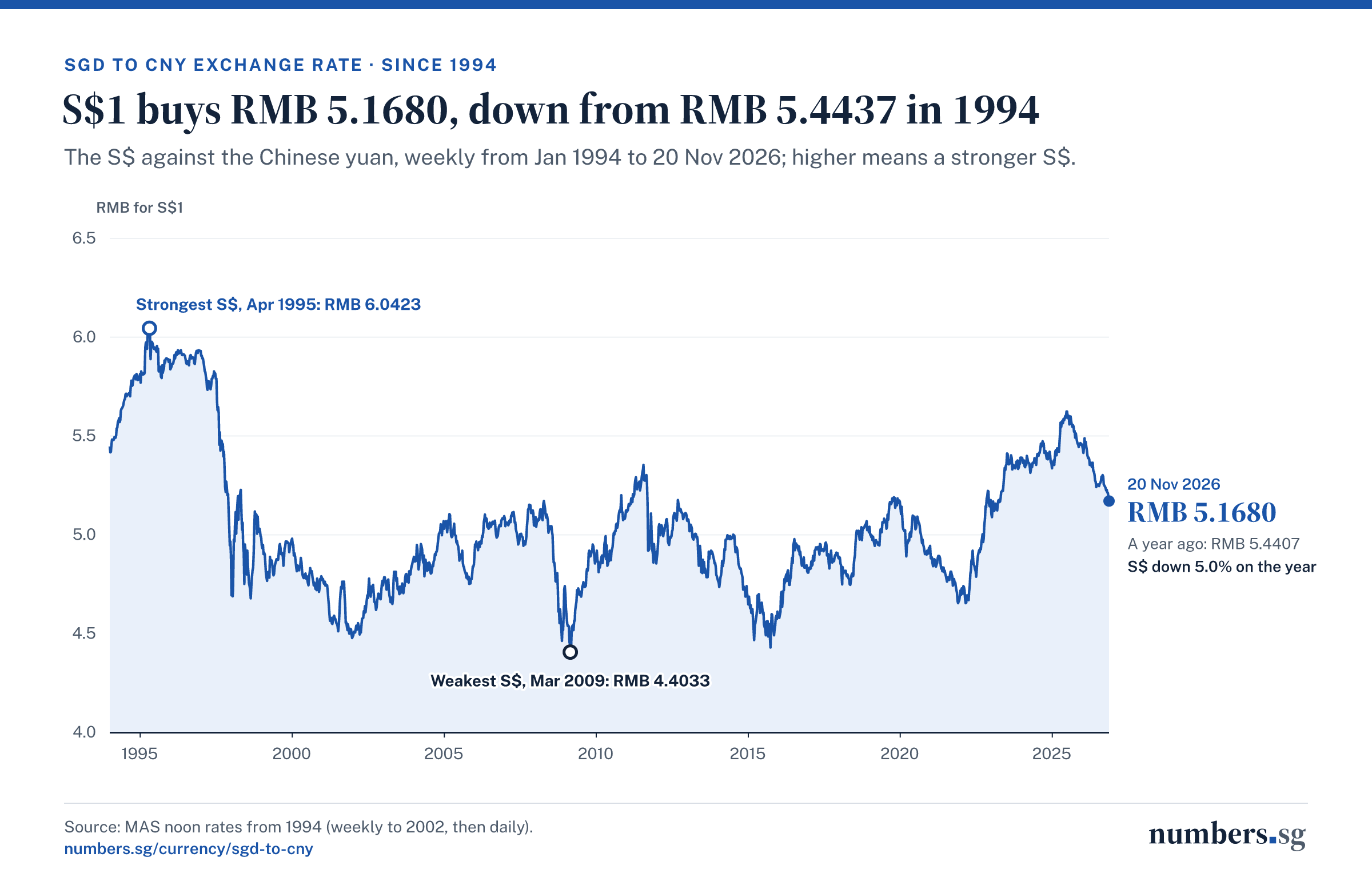
Chinese yuan for S$1, every working day since January 2003 and once a week from June 1993 to December 2002. The chart opens on the past year.
MAS, noon (once a week to 2002, then each working day) SingStat, monthly average (MAS figures)
Tap or hover on the chart to read a value.
Year by year
Chinese yuan for S$1: the average, fewest and most for each year (MAS’s weekly figures to 2002, then every working day). A plus means S$1 bought more yuan than the year before.
| Year | Average | Fewest | Most | On the year before |
|---|---|---|---|---|
| 2026 (so far) | 5.3147 | 5.1653 | 5.5066 | -3.4% |
| 2025 | 5.5022 | 5.2994 | 5.6306 | +2.1% |
| 2024 | 5.3870 | 5.2938 | 5.4825 | +2.1% |
| 2023 | 5.2743 | 5.0787 | 5.4407 | +8.0% |
| 2022 | 4.8840 | 4.6275 | 5.2274 | +1.7% |
| 2021 | 4.8001 | 4.6468 | 4.9116 | -4.0% |
| 2020 | 5.0019 | 4.8662 | 5.1733 | -1.2% |
| 2019 | 5.0651 | 4.9407 | 5.1975 | +3.3% |
| 2018 | 4.9035 | 4.7371 | 5.0659 | +0.2% |
| 2017 | 4.8949 | 4.8008 | 4.9702 | +1.7% |
The other 24 years, back to 1993
| Year | Average | Fewest | Most | On the year before |
|---|---|---|---|---|
| 2016 | 4.8123 | 4.5683 | 4.9751 | +5.2% |
| 2015 | 4.5730 | 4.4267 | 4.6992 | -6.0% |
| 2014 | 4.8643 | 4.6555 | 5.0050 | -1.0% |
| 2013 | 4.9137 | 4.7687 | 5.1046 | -2.7% |
| 2012 | 5.0501 | 4.8614 | 5.1733 | -1.8% |
| 2011 | 5.1423 | 4.8426 | 5.3619 | +3.5% |
| 2010 | 4.9689 | 4.8031 | 5.1975 | +5.7% |
| 2009 | 4.7027 | 4.4033 | 4.9480 | -4.4% |
| 2008 | 4.9196 | 4.4603 | 5.1813 | -2.5% |
| 2007 | 5.0477 | 4.9334 | 5.1573 | +0.6% |
| 2006 | 5.0193 | 4.8685 | 5.1203 | +2.0% |
| 2005 | 4.9205 | 4.7416 | 5.1151 | +0.5% |
| 2004 | 4.8980 | 4.7870 | 5.0710 | +3.1% |
| 2003 | 4.7514 | 4.6404 | 4.8662 | +2.7% |
| 2002 | 4.6256 | 4.4823 | 4.7755 | +0.1% |
| 2001 | 4.6214 | 4.4743 | 4.7733 | -3.8% |
| 2000 | 4.8039 | 4.7081 | 4.9776 | -1.7% |
| 1999 | 4.8847 | 4.7642 | 4.9702 | -1.4% |
| 1998 | 4.9533 | 4.6751 | 5.2247 | -11.5% |
| 1997 | 5.5960 | 4.9432 | 5.9277 | -5.1% |
| 1996 | 5.8965 | 5.8343 | 5.9312 | +0.1% |
| 1995 | 5.8934 | 5.7670 | 6.0423 | +4.4% |
| 1994 | 5.6472 | 5.4142 | 5.8106 | +0.4% |
| 1993 (from June, monthly) | 5.6251 | 5.4437 | 6.5488 | – |
MAS, Exchange Rates (S$ per 100 Chinese renminbi, as of noon); SingStat table M700051, Exchange Rates (Average For Period), from MAS’s figures (S$ per yuan, which we turn into yuan per S$1). Every day: download the CSV.
The yuan against the S$ over the years
Since January 1994, S$1 bought the fewest yuan, RMB 4.4033, on 2 March 2009, and the most, RMB 6.0423, on 28 April 1995. Today it buys RMB 5.1680. We count records from January 1994: MAS’s weekly figure for 18 June 1993, RMB 6.7476, is far above every rate since, so we show it in the chart and the CSV but don’t treat it as a record.
What it means in dollars. Ten years ago, on 18 November 2016, S$1 bought RMB 4.8309. A RMB 500 hotel night cost S$103.50 then and S$96.75 today, at the mid-market rate and before any change in the hotel’s own price. The other way, yuan savings of RMB 1 million were worth S$207,000 then and S$193,500 today.
Worked out by Numbers.sg from the rates above: every working day since January 2003 and once a week from June 1993 to December 2002. Past moves don’t say where the rate goes next.
The SGD to CNY rate on any date
For an expense claim, an invoice or a receipt from a trip: the rate for any working day since January 2003, and any day from June 1993 to 2002, when MAS gave one rate a week.
MAS’s rate as of noon (once a week to 2002: a day then shows the week’s rate, the nearest one before) for the day. For every day in one file, download the CSV. An expense claim or tax return may ask for a particular rate (a bank’s, or an official one): check which.
What DBS charges to change yuan
A bank posts two rates: one for selling you yuan and one for buying them back. Both give you less than the mid-market rate. The gap is the bank’s margin.
| Rate | Yuan for S$1 | Against mid-market |
|---|---|---|
| DBS buys yuan from youPosted transfer rate (CNH), 6:03 am, 22 Nov | 5.2610 | 1.80% more yuan per S$ |
| Mid-marketMAS’s rate at noon, 20 Nov | 5.1680 | – |
| DBS sells you yuanPosted transfer rate (CNH), 6:03 am, 22 Nov | 5.0925 | 1.46% fewer |
On S$1,000, DBS’s CNH rate gives RMB 5,093, RMB 75 fewer than at the mid-market rate. Changing S$1,000 into yuan and straight back at DBS’s two CNH rates would leave you with S$967.98: the gap between them is what a round trip costs.
From the data behind DBS’s foreign exchange rates page, with DBS’s own time on it (S$ for RMB 1, which we turn into yuan for S$1). DBS: “Log in now to retrieve actual rates for your transaction. Higher transaction amounts may qualify for even greater discounts.” The mid-market rate and DBS’s are set at different times, so part of the gap can be the market moving in between.
At a money changer
A changer’s yuan rate is its own and can move between morning and afternoon, so this page gives you the yardstick, not a list. In Chinatown, at People’s Park or anywhere else: read the board, put its rate into the converter, and see in yuan what it costs against the mid-market rate, Wise and DBS.
- Which number to read. Changing S$ for yuan, the changer sells you yuan: read its selling rate for RMB (or CNY). Changing yuan back, read its buying rate.
- How it’s written. Boards show yuan for S$1 (a number like 5.15), or S$ for RMB 100 (like 19.40). The converter takes either.
- Compare on the same amount. A rate a little better on paper can come with a minimum amount or apply to large notes only: ask before you change.
- Licensed or not. Money-changers in Singapore are licensed by MAS under the Payment Services Act 2019. Check a changer’s name in MAS’s Financial Institutions Directory.
Why the rate moves
MAS steers the Singapore dollar against a basket of currencies, not against the yuan alone. “MAS manages the Singapore dollar against a basket of currencies along a typically appreciating path or crawl within a policy band.” (MAS). In its October 2026 statement, MAS kept the rate of appreciation, width and centre of the S$NEER policy band unchanged (MAS, 14 October 2026).
The yuan has its own reference rate. Each working day China publishes a central parity for the yuan against other currencies, the S$ among them, through China Foreign Exchange Trade System (CFETS). So SGD to CNY is two managed currencies against each other: MAS’s band on one side, China’s daily parity on the other. Over the past year S$1 bought between RMB 5.1653 and RMB 5.5066, a swing of 6.6%. Over the same days US$1 cost between S$1.2611 and S$1.3076, a swing of 3.7%: the yuan swung 1.8 times as far against the S$ as the US dollar did.
Common mistakes
- “The rate on Google is what I’ll get.” A search page shows a market rate, much like the mid-market rate at the top of this page. In China you are more likely to pay through Alipay or Weixin on your own card, which converts at your card’s rate, not the search page’s; the table at the top shows each way on S$1,000.
- “RMB, CNY and yuan are different currencies.” Renminbi (RMB) is the currency’s name and the yuan is its unit; CNY is its code. CNH is the same yuan traded outside mainland China, at a rate that can differ a little. CNY and CNH.
- “Charging my card in S$ avoids the yuan rate.” It doesn’t: a shop, hotel or ATM in China that offers S$ uses its provider’s rate instead of your bank’s, and your bank may still add its fee. Pay in yuan.
- “SGD to CNY going up is bad.” A higher number means each Singapore dollar buys more yuan: good for a trip to China, bad for changing yuan into S$. Is today’s rate good? shows both.
From the providers’ own pages, ICA’s, the State Council’s, China’s customs guide, SAFE’s and the HKMA’s own pages and the rates above, linked in each section; the figures are this page’s, worked out from them.
Currency 10 pages
- SGD to MYRS$1 in ringgit (SGD to MYR)RM3.1888
- USD to SGDUS$1 in S$ (USD to SGD)S$1.2908
- SGD to JPYS$1 in yen (SGD to JPY)¥123.37
- SGD to IDRS$1 in rupiah (SGD to IDR)Rp 14,150
- SGD to INRS$1 in rupees (SGD to INR)₹72.17
- EUR to SGDS$1 in euros (SGD to EUR)€0.7058
- SGD to THBS$1 in baht (SGD to THB)฿26.32
- New · 9 NovSGD to PHPS$1 in pesos (SGD to PHP)₱49.48
- SGD to KRWS$1 in won (SGD to KRW)₩1,036.3
Questions people ask
What is SGD to CNY today?
S$1 = RMB 5.1680 and RMB 1 = S$0.1935 at the mid-market rate (MAS’s rate at noon, 20 Nov). S$100 is RMB 516.80; RMB 1,000 is S$193.50. A bank, card, app or money changer gives a little less: on S$1,000 the gap today runs from about RMB 29 with Instarem to RMB 236 with OFX.
How much is S$1,000 in yuan?
S$1,000 is RMB 5,168 at the mid-market rate (MAS’s rate at noon, 20 Nov). Through Wise or at DBS’s posted rates today you would get RMB 5,084 to RMB 5,113. Every way for this amount
How much is S$100 in yuan?
S$100 is RMB 517 at the mid-market rate (MAS’s rate at noon, 20 Nov). Through Wise or at DBS’s posted rates today you would get RMB 493 to RMB 509. Every way for this amount
How much is RMB 100 in Singapore dollars?
RMB 100 is S$19.35 at the mid-market rate (MAS’s rate at noon, 20 Nov). Through Wise or at DBS’s posted rates today you would get S$14.63 to S$19.01. Every way for this amount
How much is RMB 1,000 in Singapore dollars?
RMB 1,000 is S$193.50 at the mid-market rate (MAS’s rate at noon, 20 Nov). Through Wise or at DBS’s posted rates today you would get S$187.61 to S$190.08. Every way for this amount
How much is RMB 10,000 (1万) in Singapore dollars?
RMB 10,000 (1万) is S$1,935.00 at the mid-market rate (MAS’s rate at noon, 20 Nov). Through Wise or at DBS’s posted rates today you would get S$1,900.78 to S$1,917.45. Every way for this amount
What is a good SGD to CNY rate?
For changing S$ into yuan, more yuan for each S$1 is better; for changing yuan into S$, fewer. Today’s RMB 5.1680 beats 0% of working days in the past year and 61% in the past ten years for changing S$ into yuan. Over the past year the range was RMB 5.1653 to RMB 5.5066, an average of RMB 5.3302. Is today’s rate good?
What is the highest SGD to CNY rate in history?
Since January 1994, S$1 bought the most yuan, RMB 6.0423, on 28 April 1995, and the fewest, RMB 4.4033, on 2 March 2009. We count records from January 1994: MAS’s weekly figure for 18 June 1993, RMB 6.7476, is far above every rate since, so we show it in the chart and the CSV but don’t treat it as a record. The yuan over the years
What is the difference between CNY and CNH?
Both are the Chinese yuan. CNY is the rate in mainland China; CNH is the rate for yuan traded outside it, mainly in Hong Kong. DBS posts both, and today’s figures for each are in CNY and CNH.
Will the yuan go up or down against the S$?
We don’t forecast exchange rates. What this page shows is where today’s rate sits against the past year, five and ten years (is today’s rate good?) and how far it has moved before (since 1993). If your trip is months away, the rate alert emails you when S$1 buys the most yuan in a year.
Where is the best place to change yuan in Singapore?
We don’t rank providers or take payment from any of them. The table at the top shows what S$1,000 comes to each way today, re-read every hour; at a money changer, in Chinatown, People’s Park or anywhere else, put its board rate into the converter to see how it compares.
What is DBS’s yuan exchange rate?
DBS’s posted rates for selling yuan, 6:03 am, 22 Nov: RMB 5.0842 for S$1 as onshore yuan (CNY) and RMB 5.0925 as offshore yuan (CNH), against a mid-market rate of RMB 5.1680. For buying yuan back from you, DBS posts RMB 5.2610 for S$1 (CNH). CNY and CNH at DBS
Do Singaporeans need a visa for China?
Not for a stay of up to 30 days, under the mutual visa exemption that started on 9 February 2024. ICA’s words are in going to China; check the rules for your own trip before you go.
Can I use Alipay or WeChat Pay with a Singapore card?
China’s State Council says foreign users can link Visa and Mastercard cards to both, up to US$5,000 a payment and US$50,000 a year. Those limits in S$ today are in China’s limits.
Does the rate change at weekends?
MAS and the ECB publish their rates on working days only, so the main rate here stays at the last working day’s until the next. Providers set their own weekend rates: Revolut, for one, charges 1% more on exchanges at the weekend on its Standard plan, and money changers set their own rates every day.
How we get these rates
- The main rate is MAS’s own figure for S$ per 100 Chinese renminbi, which MAS gives “as of noon” each working day (MAS, Exchange Rates), turned into yuan per S$1. When MAS’s site can’t be read, as during its maintenance, the main rate is the European Central Bank’s: its euro reference rates for the yuan and the S$ give yuan per S$1 for the same day (ECB, each working day since 1 April 2005, when the yuan joined its list). The page says which one it is showing. Both are read every hour from 9:15 am to 6:15 pm; at weekends and on holidays the rate stays at the last working day’s.
- Check: MAS’s and the ECB’s rates for the same day must agree within 1%, or the job flags it for a person to look at.
- Before 2003: MAS gave one rate a week, so from June 1993 to December 2002 the chart, the year table, the records and the CSV hold one rate a week, as MAS published them. The year table’s first year is SingStat’s monthly averages (table M700051).
- DBS: its posted telegraphic transfer rates for onshore yuan (CNY, selling only) and offshore yuan (CNH, both ways), from the data behind DBS’s foreign exchange rates page, with DBS’s own effective time. DBS: “Log in now to retrieve actual rates for your transaction. Higher transaction amounts may qualify for even greater discounts.”
- Wise: Wise’s public price comparison (wise.com), read every hour from 9:15 am to 6:15 pm, every day, at S$100, 500, 1,000 and 5,000 and, the other way, RMB 1,000, 5,000, 10,000 and 50,000. Wise’s fee there is a fixed part plus a share of the amount; we fit both to Wise’s four quotes to work out the fee on any amount. Other providers’ prices are as Wise collected them, with Wise’s times, for S$1,000 only.
- Cards: DBS and POSB’s published fees (3.25%, DBS and POSB); YouTrip’s (YouTrip) and Trust’s (Trust) own pages; Revolut Singapore, Personal Fees (Standard), version 0.8.1. Card rows use the mid-market rate in place of Visa’s or Mastercard’s own rate, which we don’t read, so they say “about”.
- Rules quoted (ICA on the visa exemption; China’s State Council on paying by card and the tax refund; China’s customs guide on cash; SAFE on its quota; the HKMA on CNH; the Singapore Police Force on cash) are word for word from each one’s own page, read 2 Nov 2026, and re-read on our update schedule.
- Not shown, on purpose: China’s central parity, which CFETS publishes but whose terms need written permission to republish; and a figure for Alipay’s or Weixin’s own fee on a foreign card, which we found on no page of theirs.
- A new rate is refused if it is outside 2 to 12 yuan for S$1, or if the main rate moves more than 4% from our last read within four days; the page then keeps the last good read and says when it was.
- Numbers.sg is not connected to any bank, card, app or money changer named here; no one pays us, and this page has no affiliate links. It is not advice on when or how to change money. The converter runs in your browser; nothing you type is sent anywhere. See our disclaimer, how we get our numbers and corrections.
Changes to this page
- Correction
SGD to CNY: the page called MAS’s figures daily back to 1993; they were weekly until the end of 2002. The highest rate on record, 6.7476 yuan for S$1, was labelled a SingStat monthly average; it is MAS’s weekly figure for 18 June 1993, and the page now says so. The whole-record row in “Is today’s rate good?” now counts working days from 2003 only, so it no longer mixes weekly and daily figures.
New: SGD to CNY, with DBS’s onshore (CNY) and offshore (CNH) rates side by side. The page explains paying with Alipay or Weixin on a Singapore card, China’s 30-day visa exemption and tax refund in the government’s words, sending yuan to Singapore, and amounts typed as 3万 or 30k. Daily rates from 2005, monthly from 1993, and email alerts.
SGD to CNY: the highest and lowest rates now count from January 1994. SingStat’s figure for June 1993 (RMB 6.5488 for S$1) is far above every month since, so it stays in the chart, the year table and the CSV but is no longer shown as the record high.
- Correction
Corrected: on our SGD to CNY page, under “Is today’s rate good?”, the sentence on changing yuan into S$ said your yuan bought fewer S$ today than on a share of days, but gave the share of days on which they bought fewer S$ than today, the opposite. It now gives the right share. The table beside it and the figures for changing S$ into yuan were right.